
By LocalAds.ie Editorial Team
How to Arrange Collection and Delivery for Used Furniture
Plan access, lifting, vehicles, protection, payment and handover so second-hand furniture reaches its destination safely and without last-minute surprises.
Published 7 September 2026 - 12 min read
A second-hand furniture deal is not complete when the price is agreed. The item still has to leave one property, fit a suitable vehicle and enter another without injuring anyone or damaging the furniture, buildings or road users. Good collection arrangements begin before an offer: measure the item, inspect both routes and decide who is responsible for each stage.
Choose the handover method first
Three common arrangements
- Buyer collection: the buyer organises people, vehicle, protection and load security.
- Seller delivery: the seller agrees a price, distance, timing and exact delivery point.
- Independent mover: buyer and seller confirm who hires, instructs and pays the provider.
Write the chosen arrangement in messages. State whether delivery means kerbside, building entrance or placement inside a room, and whether stairs are included. Clarify who dismantles and reassembles the item and what happens if access information proves wrong. A vague promise to ‘drop it over’ is not a transport plan.
Measure the furniture at its largest point
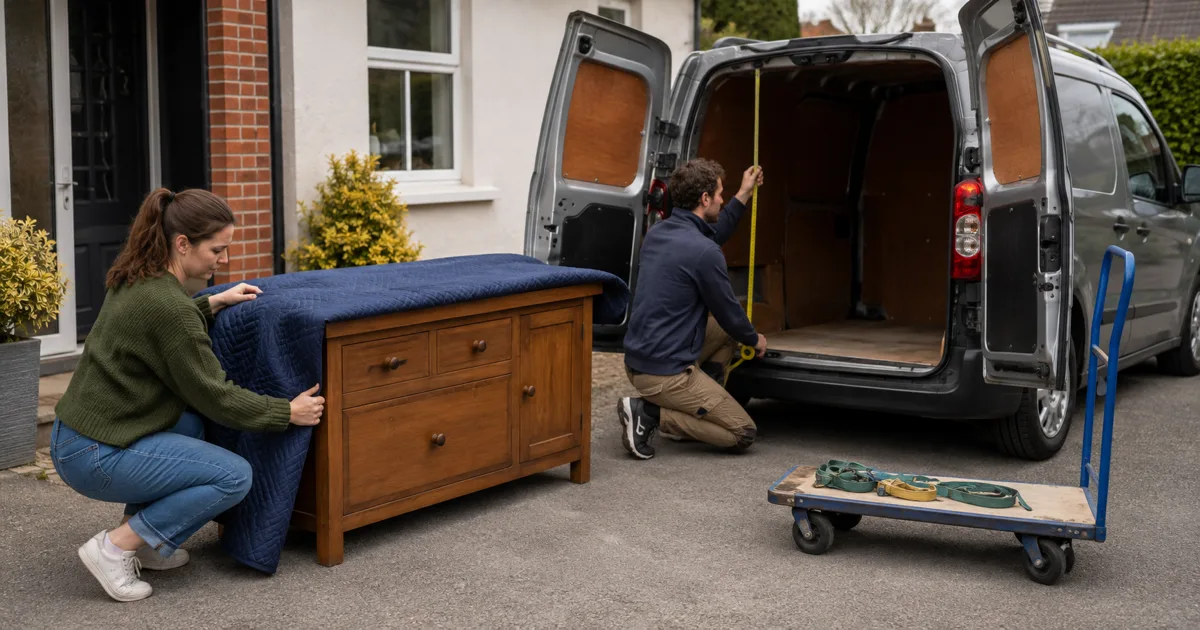
Record maximum width, height and depth, including arms, handles, feet, cornices and fixed cushions. For a sofa, include diagonal depth; for a table, measure the top and base; for a wardrobe, identify the longest rigid panel. Weigh the item if reliable information is available, or treat an unknown solid piece as heavy. Confirm which parts genuinely detach and what tools or instructions are required.
Check both access routes
Walk from the furniture to the loading point at collection, then from unloading point to final room. Measure the narrowest doors, stairs, lifts, landings, gates and turns. Note low ceilings, fragile floors, loose gravel, slopes and parking distance. Remove trip hazards before arrival but do not dismantle fixtures or alter a property without authority.
Access details to exchange
- Approximate collection and delivery areas before a deal, with precise addresses shared privately when confirmed.
- Floor level, lift dimensions and number or shape of stairs.
- Door, hallway and landing measurements at tight points.
- Legal parking position and distance from door to vehicle.
- Time restrictions, apartment rules and whether another adult will be present.
- Any glass, mechanism, exceptional weight or part requiring specialist handling.
Inspect before dismantling or loading
The buyer should compare the actual item with the advert before work begins. Check dimensions, structure, upholstery, odour, mechanisms, included parts and disclosed faults. If something material differs, resolve it before dismantling. Once a piece is separated and wrapped, condition becomes harder to assess and responsibility for new damage becomes less clear.
Prepare furniture for movement
Empty drawers and cupboards. Remove loose shelves, cushions and extension leaves; secure doors only with materials that will not damage the finish. Photograph the assembled furniture and every connection. Label components, keep fasteners by stage in sealed bags and protect exposed corners. Never use doors, drawer fronts, rails or decorative trim as lifting handles.
Use clean moving blankets, edge guards and stretch wrap where suitable, while avoiding adhesive tape directly on finished timber, leather or fabric. Protect glass or mirrors separately and keep them upright in a purpose-appropriate support. Moisture trapped beneath plastic can affect some finishes, so keep the journey dry and unwrap at the destination.
Match the vehicle to the complete load
Measure usable cargo width, height and length, accounting for wheel arches, door openings and tie-down points. Confirm the vehicle’s payload and do not assume empty floor area means unlimited capacity. Furniture should travel inside a suitable enclosed vehicle where possible. It must not obstruct the driver, passengers, lights or number plates, and vehicle doors must close securely.
Secure the load in every direction
The Road Safety Authority states that a road load must be distributed, packed, adjusted and attached so it is not likely to cause danger or interfere with vehicle stability. Furniture can slide, tip or move upward during braking, cornering and evasive action, even on a short slow journey. Use sound, suitable restraints and proper anchor points; blankets protect surfaces but do not restrain weight.
Place heavier pieces low and arrange weight evenly without exceeding axle or vehicle limits. Block movement where appropriate and use rated straps in good condition without crushing weak panels. Recheck the load after initial movement if it is safe to stop. If you do not know how to secure the furniture correctly, hire a competent mover rather than experimenting on a public road.
Plan lifting, not just transport
Count capable people according to the weight, shape, grip and route. A bulky light item can be difficult because it blocks vision and forces awkward posture. Clear the path, agree commands and identify where the load can be set down safely. Use an appropriate trolley, lifting aid or professional service to reduce handling. Do not attempt a lift that requires twisting on stairs, reaching above safe control or stepping backwards into an unseen route.
Hiring a furniture mover
Give movers photographs, dimensions, estimated weight, both postcodes or areas, floors, stairs, lift details, parking distance and any dismantling requirement. Ask what the quote includes, whether it is fixed or time-based, how waiting is charged, and what happens if the furniture does not fit. Check the provider’s identity, contact details, insurance position and cancellation terms independently before paying.
Confirm with a mover in writing
- Collection and delivery windows rather than an unrealistic exact minute.
- Item count, dimensions and special materials such as glass or marble.
- Inside delivery, stairs, dismantling, reassembly and packaging responsibilities.
- Total price, VAT status where relevant, payment timing and cancellation terms.
- How damage, delays and access problems are reported and handled.
Seller delivery needs boundaries
A private seller offering delivery should define the distance, fee, timing, vehicle and unloading help. Do not arrive at an undisclosed staircase expecting the seller to carry a heavy item inside. Decide whether the sale is final after inspection at collection or after delivery, and document any delivery charge separately. Sellers should never overload an unsuitable car merely to preserve a sale.
Keep payment separate from courier tricks
Unexpected courier links, insurance deposits, account upgrades and release charges are common warning signs. A marketplace buyer does not need the seller’s bank password, card PIN or one-time code to arrange collection. Do not trust a payment screenshot or email; the recipient must verify cleared funds in their own account. Independently contact any delivery company through confirmed details, not a link supplied in a pressured message.
Manage timing and privacy
Agree a realistic window and exchange a message before departure. Share the exact private address only with the confirmed party when necessary. Have another adult present for a home collection, keep unrelated rooms closed and secure pets and children away from the route. If either side is delayed, update the other rather than rushing lifting or driving.
At the destination
Inspect packaging before unloading and photograph any obvious new damage. Recheck the entry route, protect floors and walls, and move components in the planned order. Account for every labelled fixing before assembly. Follow manufacturer instructions where available, keep fingers clear of mechanisms and use appropriate wall restraints for tall furniture. Do not force an item through an opening when the measured plan has proved wrong.
Final collection and delivery checklist
- Item, price, dimensions and included parts are confirmed in messages.
- Both access routes and the vehicle opening have been measured.
- The buyer inspects before dismantling and payment.
- Responsibilities for packing, lifting, stairs and assembly are explicit.
- Enough people, protective materials, tools and suitable equipment are ready.
- The vehicle is suitable and the load is restrained in every direction.
- Payment is verified independently without unexpected courier links or fees.
- Condition and parts are checked again before the transaction is closed.
Reliable furniture collection is deliberately uneventful. Everyone knows what is moving, where it must pass, who will lift it and how it will be restrained. That preparation protects the people involved and preserves the value that made buying second-hand worthwhile.
Tags
More from
New related stories are added frequently.