
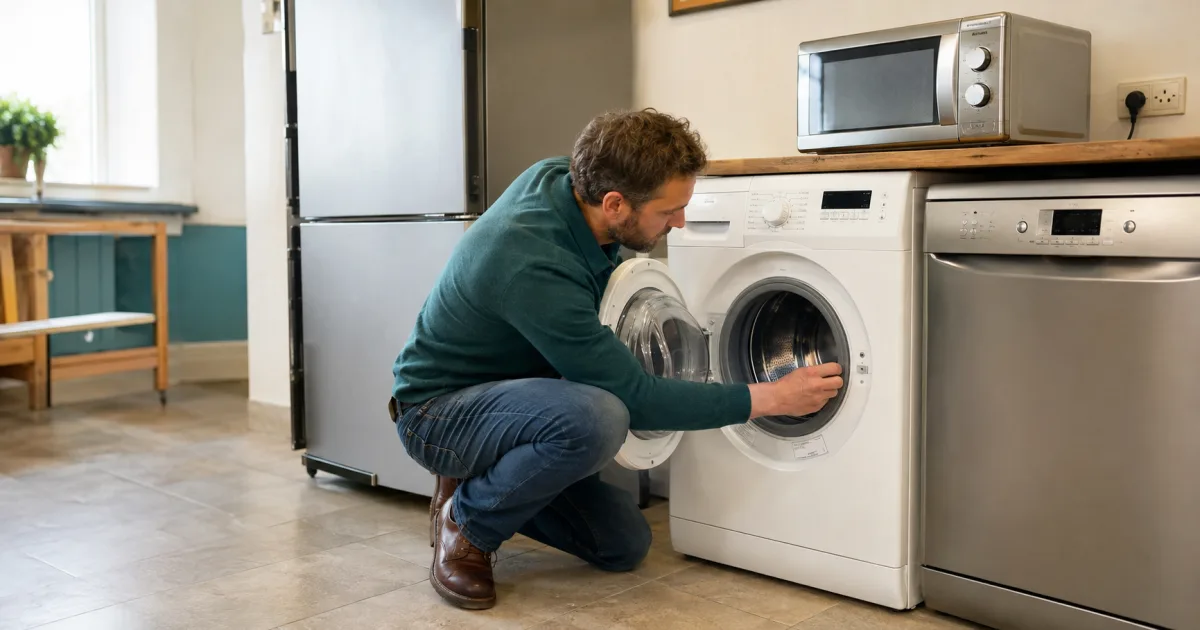
By LocalAds.ie Editorial Team
Buying Second-Hand Appliances in Ireland: A Practical Guide
Choose a suitable used appliance, verify its identity and condition, test it properly and plan a safer collection without overlooking running costs.
Published 7 September 2026 - 12 min read
A second-hand appliance can reduce the cost of setting up a home, replace a failed machine quickly and keep useful equipment in service. The saving is real only when the appliance fits, performs its main functions, can be moved safely and is not unusually expensive to run. Treat the advert as the beginning of an inspection rather than proof of condition, and agree the important facts in messages before travelling.
Choose the appliance before choosing the advert
Write down the required appliance type, maximum external dimensions, usable capacity, installation constraints and essential programmes. A cheap large fridge may consume unnecessary floor space and electricity; a narrow washing machine may fit the gap but still need clearance for hoses and the open door. Decide which features are genuinely necessary so an impressive specification does not distract from poor fit or condition.
Measure the complete installation
- Width, height and depth of the available space, including skirting boards.
- Door, lid, drawer and ventilation clearance required in normal use.
- Water inlet, waste, socket and approved connection positions.
- Every doorway, stair, lift and turn along the delivery route.
- The vehicle opening and protected space needed to keep the appliance upright where required.
Freestanding and integrated appliances are not automatically interchangeable. An integrated model may require matching hinges, brackets, ventilation and a suitable cabinet door. Cookers, ovens and other high-load or fixed appliances may need a competent installer and the correct electrical or gas connection. Do not buy on the assumption that an adaptor or improvised extension will make an incompatible appliance suitable.
Identify the exact model
Ask for a clear photograph of the rating or data plate and record the manufacturer and complete model number. The plate may be inside a door, behind a drawer or on the rear. Use the model—not appearance alone—to find the manual, dimensions, capacity, installation instructions, energy information and available spare parts. Keep serial numbers private where publishing them would create a security or registration risk.
Search the model on the manufacturer’s official support site and check recognised product-recall sources before agreeing a sale. Similar-looking products can have different revisions, so compare all relevant identifiers. If a recall applies, follow the official remedy instructions; do not accept a seller’s assurance that a safety defect is harmless or easy to bypass.
Understand who is selling
Consumer protection depends on whether the seller is acting as a business or as another consumer. The Competition and Consumer Protection Commission explains that second-hand goods bought from a business must meet consumer-law standards, taking account of disclosed wear and price. A private consumer-to-consumer purchase does not carry the same consumer-law protection, so the buyer is responsible for checking the item carefully. A trader cannot legally disguise a business sale as a private one.
Ask directly whether the seller is a private owner or business. A business should provide its identity, terms and a receipt or invoice. Read any guarantee or refurbishment description precisely: ‘tested’, ‘serviced’ and ‘refurbished’ do not tell you the same thing unless the seller explains what work was completed, by whom and what remedy is offered if a fault appears.
Read the advert for evidence
Useful adverts show the actual appliance from the front, sides, rear, interior, controls, connections and identification plate. They state approximate age, known faults, repairs, reason for sale and what is included. Catalogue photographs, ‘working when last used’ or ‘should be an easy fix’ leave important questions unanswered. Ask for current photographs or a short live demonstration rather than relying only on an old video.
Questions to ask before travelling
- What is the complete model number and approximate purchase date?
- Which programmes and functions were tested, and when?
- Are there error codes, leaks, unusual sounds, smells or intermittent faults?
- What repairs or parts replacements have been completed?
- Are hoses, shelves, trays, brackets, manuals and transport bolts included?
- Why is it being sold, and how long has it been disconnected or stored?
Inspect condition before power-on
Begin with the appliance unplugged. Inspect the casing, feet, door, hinges, seals, drum or cavity, shelves, controls and accessible connections. Look for corrosion, impact damage, mould, pest evidence, water marks, grease buildup and repairs that do not look original. Check the entire visible cable and plug for cuts, crushing, heat damage, exposed conductors, loose pins or tape. Decline an appliance with unsafe wiring or unexplained scorching rather than trying it.
Smell can reveal persistent contamination or overheating that photographs cannot show. Open doors, detergent drawers and filters where the seller permits. A clean exterior does not prove a clean drain path, sound compressor or healthy bearing. Cosmetic wear may be acceptable at the right price; structural damage, leaks, unsafe electrical work and unavailable essential parts deserve much more caution.
Test the functions that create the value
Ask the seller in advance to keep the appliance connected only when it is safe and normal to do so. Watch it start, respond to controls and complete enough of an ordinary cycle to reveal obvious problems. Do not remove covers, defeat interlocks, touch exposed parts or improvise water, gas or electrical connections. If a safe meaningful demonstration is impossible, value the item as unverified and be prepared to leave.
Practical category checks
- Washing machine: door lock, fill, drum rotation, heating if observable, drain, spin, seal and leaks.
- Dishwasher: fill, spray action, detergent flap, heat, drain, racks, seals and leaks.
- Fridge or freezer: stable cooling from a properly settled unit, door seals, compressor sound, interior damage and frost pattern.
- Tumble dryer: drum, heat or heat-pump operation, filters, water container or drain and abnormal noise.
- Oven or hob: correct controls, elements or zones, door, seals, fan and safe installation requirements.
- Small appliance: every speed or setting, cable strain relief, switches, attachments and safe shutdown.
A brief switch-on cannot prove long-term reliability. Cooling appliances need time to stabilise, while intermittent faults may appear only under load. Request service or repair records where available and price uncertainty honestly. For an expensive appliance, a trader-tested or professionally assessed unit with clear after-sales terms may provide better overall value than an undocumented private bargain.
Compare energy use, not just the purchase price
Find the model’s energy label or product information through a reliable source. SEAI explains that the current label generally uses an A-to-G efficiency scale and also shows consumption in kWh per year or per 100 cycles, depending on the appliance. Compare the actual consumption figure, capacity and likely household use. A large appliance can use more energy overall than a smaller one even when its efficiency class looks better.
Estimate annual running cost using the consumption figure and your own electricity unit rate rather than a generic price that may become outdated. For washing machines and dishwashers, consider water use and realistic cycles per week. Add likely installation, missing parts and immediate maintenance. A newer €220 machine that costs less to run and includes delivery may beat a €100 machine requiring a van, hoses and an early repair.
Check repairability and parts
Search the manufacturer’s support pages for the manual, authorised service options and ordinary replacement parts such as seals, shelves, filters, baskets and hoses. SEAI notes that ecodesign rules for certain household appliances include spare-parts and repair-information requirements, but availability still depends on the exact product and component. Do not assume every older model can be repaired economically.
Plan collection before making an offer
Confirm the collection floor, stairs, lift, parking distance, appliance weight and who will disconnect and lift. Water, gas and fixed electrical connections should be isolated correctly; use an appropriately qualified person where required. Drain water, secure hoses and loose internal parts, and use the manufacturer’s transport instructions. Washing-machine transport bolts matter, and many refrigeration appliances need to remain upright and stand for a specified period before power is restored.
Use enough capable people, a suitable trolley, protective materials and a vehicle with proper restraint points. Never lift by a door, control panel, cable or hose. Keep the appliance restrained in every direction without crushing weak panels, protect the property route and do not overload a car. If weight, stairs or disconnection exceed your experience, include a competent delivery service in the budget.
Pay only after inspection
Keep the model, represented condition, included parts, price and collection arrangement in LocalAds.ie direct messages. Inspect and test before paying where possible. Do not send deposits because a seller claims several buyers are waiting, and never pay an unexpected courier insurance, account-upgrade or release fee. Verify any electronic payment inside your own banking service; screenshots and emails are not proof that money cleared.
Know when not to buy
- The model identity is removed, inconsistent or cannot be verified.
- A relevant recall has no confirmed official remedy.
- The plug, cable, casing or connections show dangerous damage or modification.
- The seller refuses a reasonable inspection while claiming full working condition.
- Water leaks, burning smells, serious corrosion or abnormal mechanical noise appear.
- Essential parts are unavailable or total repair and transport cost defeats the saving.
- Payment pressure or an unrelated courier process replaces a normal local transaction.
Reuse responsibly—or recycle it
Buying second-hand is beneficial only when the appliance remains safe and useful. Do not pass a dangerous or irreparable unit to another buyer with a vague description. WEEE Ireland provides authorised collection-point information for electrical and electronic waste and states that householders can recycle through authorised routes free of charge. Follow the applicable retailer, civic amenity or WEEE collection instructions and handle batteries separately where directed.
Final second-hand appliance checklist
- The appliance, doors, ventilation and connections fit the home.
- Manufacturer, model, age, ownership and seller status are reasonably clear.
- Recall information, manual, energy use and parts availability have been checked.
- Cable, plug, casing, seals, controls and accessible components show no unsafe defect.
- The seller demonstrated the important functions in a safe, ordinary setup.
- Faults, repairs, included parts, price and collection terms are recorded in messages.
- Disconnection, lifting, restraint, installation and running costs fit the total budget.
- Payment happens only after inspection, without courier links or invented fees.
A strong used-appliance purchase is not simply the lowest asking price. It is the correct model for the space, with verifiable identity, acceptable condition, a meaningful test and a realistic lifetime cost. When those pieces align, a second-hand appliance can be practical value; when they do not, walking away is cheaper than inheriting an unsafe or unserviceable machine.
Tags
More from
New related stories are added frequently.