
By LocalAds.ie Editorial Team
Buying a Second-Hand Sofa: What to Check Before You Pay
Use this practical Irish buyer’s checklist to measure, inspect and test a second-hand sofa before agreeing a price, collection or payment.
Published 7 September 2026 - 12 min read
Buying a second-hand sofa can save a substantial amount and keep useful furniture in circulation, but a good photograph and a low asking price do not tell you whether it will fit, feel comfortable or survive the journey home. The safest approach is to treat the advert, inspection and collection as three separate checks. Confirm the facts first, inspect the actual sofa in person and pay only when the item matches what was agreed.
Measure the room and the entire route
Start at home before contacting a seller. Measure the available wall or floor area, but also allow for radiators, sockets, skirting boards, windows, doors and the space needed to walk around the sofa. Mark the proposed footprint with masking tape or sheets of newspaper. This gives a more realistic sense of scale than comparing the sofa with furniture in somebody else’s room.
Then measure every part of the delivery route: building entrance, hallway, internal doors, stair width, landings, low ceilings and lift dimensions. Record the narrowest width and height, and consider whether the sofa must turn a corner. Ask for the sofa’s full width, height and depth, plus its diagonal depth. Confirm whether the legs, arms or sections detach without damaging the frame. A sofa that fits the sitting room may still be impossible to bring through the front door.
Measurements to confirm in writing
- Overall width from the outside edge of one arm to the other.
- Maximum height, including fixed back cushions or headrests.
- Maximum depth and the diagonal depth needed to pivot through a doorway.
- Seat height and depth if comfort or accessibility matters.
- Dimensions of each section for a corner, modular or reclining sofa.
- The narrowest doorway, stair turn, lift and gate on the collection and delivery routes.
Read the advert for what it does not say
Look for photographs of the front, back, sides, cushions, legs and underside. A single distant image cannot show wear. Ask the seller how old the sofa is, whether they bought it new, why it is being sold and whether it has been repaired or stored outside the main living area. Also ask about smoking, pets, damp, spills and strong cleaning products. These questions are not accusations; they identify conditions that can be difficult to remove after collection.
Request fresh close-ups of any worn area and a photograph of the manufacturer or product label if available. For a sofa bed or recliner, ask for a short description of how every mechanism operates and whether any cable, transformer or remote is included. Keep the answers in direct messages so you can compare the sofa at collection with the description you relied on.
Inspect the frame before judging the fabric
Upholstery is visible, but the frame determines whether a sofa remains usable. Stand back and check that the body is level, the arms are symmetrical and the legs sit squarely. With the seller’s permission, lift one front corner a few centimetres. The adjacent corner should begin to rise rather than allowing the frame to twist dramatically. Sit gently in every position and listen for repeated cracking, clicking or movement at the joints.
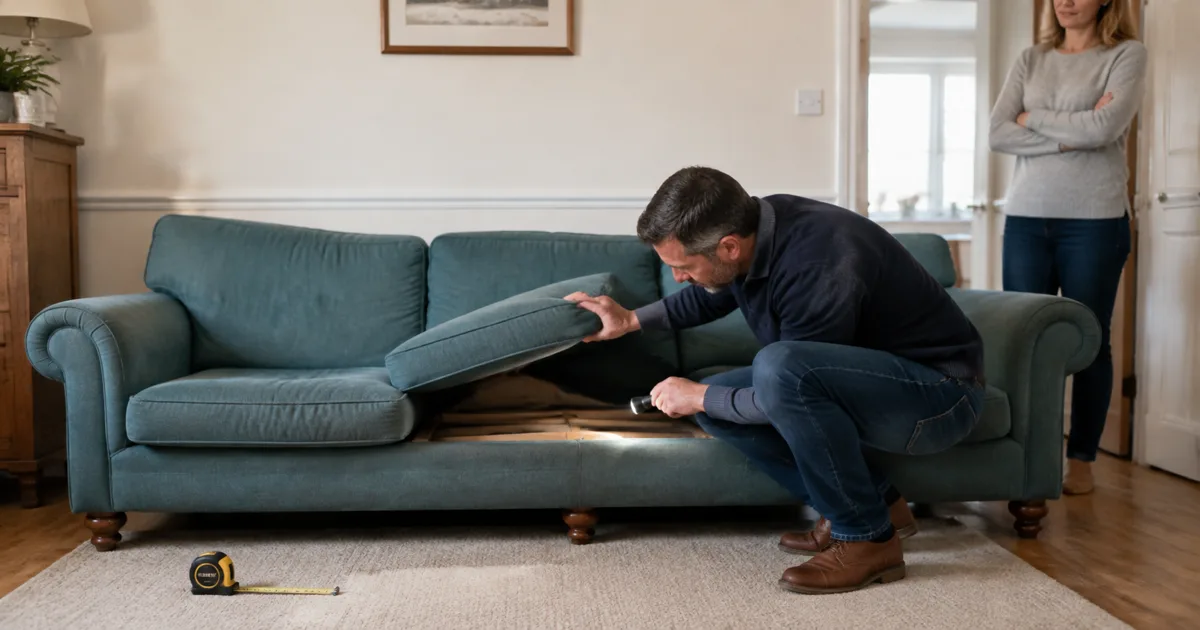
Look underneath with a torch. Check for split timber, bent metal, loose bolts, fresh glue, improvised brackets and damage around the legs. A neat professional repair may be acceptable if it is disclosed and reflected in the price; a concealed structural repair is a reason to slow down. Do not remove fixed upholstery or put your hands into spaces you cannot see.
Check springs, webbing and seat support
Remove loose seat cushions and inspect the platform beneath them. Springs should not protrude, and webbing or fabric support should not be torn or hanging. Press across the full seat rather than testing only the least-used end. Uneven sinking, a hard ridge or a seat that does not recover may indicate tired foam or failed support. Compare identical cushions side by side because one heavily used cushion can hide among better ones.
Open cushion zips carefully if the seller agrees. Check whether the covers are genuinely removable and whether the foam is crumbling, permanently compressed or cut to the wrong shape. Confirm the care label before assuming a cover can be machine washed. Replacing foam or hiring an upholsterer may still make sense, but include that cost in the decision rather than treating it as a free future fix.
Inspect upholstery, seams and hidden surfaces
Use daylight where possible. Look across the fabric from different angles for fading, shiny wear, pilling, stretched panels, scratches, burns and colour variation. Check piping, corners, arm fronts and the seams around zips because these areas often fail first. Lift every loose cushion and inspect the gaps, rear panel and lower edge. For leather, distinguish normal creasing from peeling coatings, dry cracks or torn stitching.
Smell the sofa at close range without pressing your face into it. Smoke, damp, pet urine and heavy fragrance can remain inside foam even when the surface looks clean. Dark spotting, tide marks, a musty smell or damp-feeling material deserves caution. Check seams and folds for unexplained spots, shed material or insect activity. If you suspect pests or significant mould, do not bring the sofa into your vehicle or home; professional treatment can cost more than the item is worth.
Test recliners and sofa beds safely
Ask the seller to demonstrate moving mechanisms before you operate them. Extend every recliner fully, then return it to its closed position and check that both sides align. Inspect accessible cables for cuts, crushed sections or taped repairs, and confirm that the correct power supply and controls are present. For a sofa bed, open it completely, examine the support, mattress, hinges and locking action, and make sure it can be closed without force. Keep fingers, children and pets away from pinch points.
Check safety information and seller status
Ask whether the original manufacturer and product information is still attached and photograph it for your records. Never buy upholstered furniture that appears fire-damaged, has exposed filling, carries a product recall that has not been remedied or has been altered in a way that may make it unsafe. A missing label on an older private-sale sofa does not by itself reveal the sofa’s history, so judge the complete evidence and do not accept confident safety claims that the seller cannot support.
In Ireland, your consumer protections depend on who is selling. When a business sells second-hand goods, the goods must meet applicable consumer-law requirements, taking their used condition and disclosed faults into account. A trader must not disguise themselves as a private seller. When buying from another private individual, consumer law does not provide the same protections and the buyer is responsible for carrying out careful checks. Ask directly whether the seller is acting privately or as a business before paying.
Calculate the real price
Compare the asking price with sofas of a similar maker, size, age and condition, not with a new retail price chosen by the seller. Add van hire, fuel, tolls, parking, lifting help, cleaning, replacement feet, foam and repairs. A free sofa can become expensive if it needs professional treatment or cannot pass through your doorway. Conversely, a sound sofa with disclosed cosmetic wear may offer better value than a spotless-looking one with structural problems.
Walk away when
- The dimensions, model or condition do not match the advert or messages.
- The seller refuses a reasonable inspection but demands a deposit or full payment.
- There is persistent damp, a strong unexplained odour, suspected pests or unsafe exposed filling.
- The frame twists, major joints move, springs protrude or a mechanism cannot be demonstrated safely.
- A payment or courier story introduces an unexpected link, release fee or account-upgrade charge.
- The collection location or behaviour makes you feel unsafe.
Plan collection before making an offer
Confirm the collection floor, stairs, lift, parking distance and whether the seller can help. Bring enough capable adults, a suitable vehicle, blankets, straps and basic tools for removable feet or approved modular connections. Photograph how parts fit before dismantling, place fixings in a labelled bag and protect fabric from rain. Never overload a vehicle, obstruct the driver’s view or leave doors unsecured. Use a professional furniture mover when the route, weight or mechanism exceeds what your group can handle safely.
Share an exact home address only once a genuine collection is agreed. For a home pickup, tell another person where you are going and avoid carrying a large amount of cash unnecessarily. Agree the item, final price and included parts in messages, but retain the right to decline if inspection reveals something material. If paying electronically, the seller should verify cleared funds in their own account rather than relying on a screenshot or email.
Your final five-minute sofa check
- Match the sofa and all included pieces to the advert photographs.
- Recheck overall dimensions and confirm removable sections or feet.
- Sit in every seat and inspect the frame, underside, support and cushions.
- Check fabric, seams, odour, damp signs and concealed surfaces in good light.
- Demonstrate every recliner or bed mechanism and collect its controls or power supply.
- Confirm the total price, loading help, route and safe vehicle plan before payment.
A worthwhile second-hand sofa does not need to be perfect. It needs to fit your space, have a sound structure, match the seller’s description and cost an amount that still makes sense after transport and cleaning. Taking twenty careful minutes at inspection is far easier than moving an unsuitable sofa twice.
Tags
More from
New related stories are added frequently.