
By LocalAds.ie Editorial Team
How to Choose the Right Second-Hand Bike for Your Child
Choose a correctly sized used children’s bicycle, inspect its frame and brakes, check ownership and plan a safe first ride in Ireland.
Published 7 September 2026 - 14 min read
Children can outgrow bicycles quickly, so buying second-hand often makes excellent financial and environmental sense. The right purchase is not simply the cleanest bike in your child’s favourite colour. It must fit now, allow confident braking and steering, have a sound frame and credible ownership, and leave enough budget for a helmet, lights, lock and any workshop attention.
Buy for the child who will ride it now
Avoid a bicycle that your child is expected to grow into. Cycling Ireland guidance says a child should ride a bicycle they can grow out of, not into. An oversized bike can make starting, stopping and steering harder at the exact stage when confidence is developing. A smaller, lighter, correctly fitted bicycle is usually more useful than a feature-heavy model that intimidates its rider.
Think about current ability as well as age. A child learning to balance needs low-speed control and easy ground contact. A confident rider may be ready for gears or longer journeys, but extra controls still need to fit small hands. Age ranges printed on adverts are rough marketing categories, not proof of fit.
Measure the child before browsing
Measure height and inside leg while the child wears the shoes normally used for cycling. Ask the seller for wheel size, frame size, saddle-height range and exact model. Wheel diameter—often described in inches—is a useful filter, but two bicycles with the same wheel size can have different frame geometry, crank length, handlebar reach and minimum saddle height.
Information to request before travelling
- Exact make, model and approximate year.
- Wheel and tyre size printed on the sidewall.
- Minimum saddle height measured from ground to saddle top.
- Frame or recommended rider-size information from the manufacturer.
- Photographs of both sides, brakes, tyres, drivetrain and frame-number area.
- Any faults, repairs, impacts, missing parts or components that do not work.
Use the manufacturer’s size guide when available, then confirm fit in person. Do not buy solely from a generic wheel-size chart found online. Children of the same height can have different proportions and confidence, and frame designs vary significantly.
Perform a stationary fit check
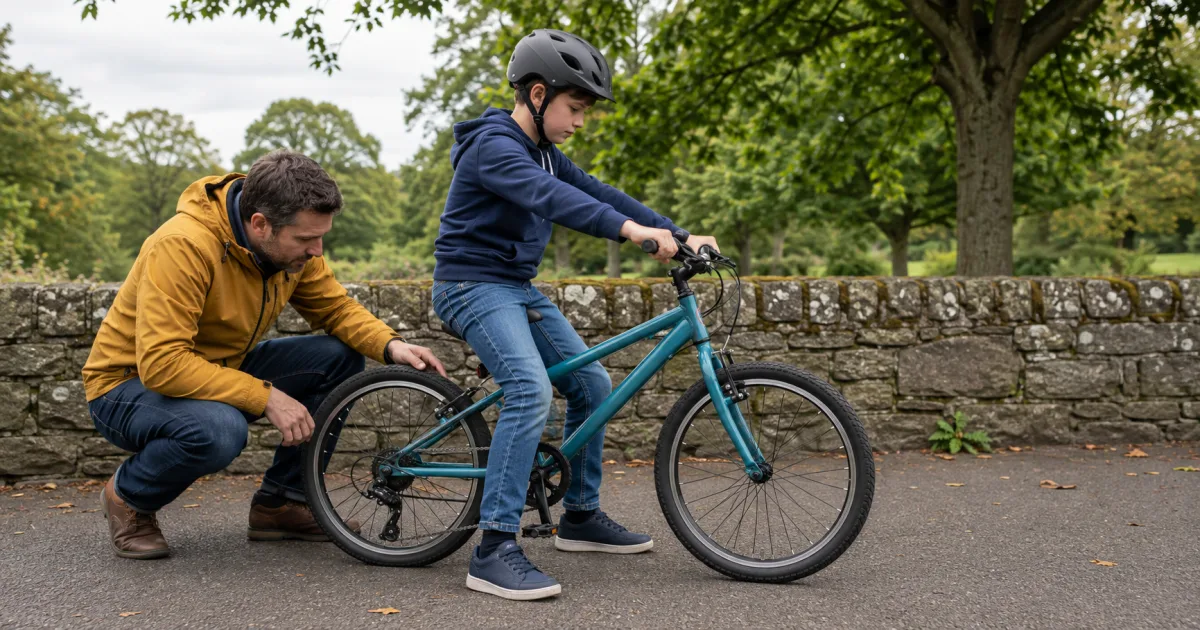
Choose a flat, traffic-free surface and have an adult hold the bicycle securely. Set the saddle near its lowest usable position without exceeding any limit marks. For a beginner, the child should be able to sit, hold the bars and place both feet confidently on the ground. Cycling Ireland warns that tiptoeing from side to side hampers stopping and control.
Ask the child to reach both grips and brake levers. Shoulders should look relaxed rather than stretched, knees should clear the handlebars during ordinary steering and the child should be able to squeeze the brakes without releasing the grip. Check standing clearance over the frame and make sure mounting and dismounting feel controlled.
The fit is wrong when
- Only toes reach the ground at the lowest safe saddle setting.
- Arms are locked straight or the child must lean excessively to reach the bars.
- Brake levers are beyond comfortable finger reach.
- Knees hit the handlebars or remain excessively bent while pedalling.
- The saddle or handlebar must exceed a minimum-insertion mark.
- The child looks frightened by the bicycle’s height or weight.
Weight matters more than many features
A heavy bicycle is harder for a small rider to start, steer, lift after a fall and control on a slope. Compare the bike’s real weight with the child’s size and strength. Low-cost suspension, multiple chainrings, decorative steel parts and oversized tyres can add kilograms without improving ordinary park or school riding.
Ask the child to walk the bicycle, turn it around and lift it slightly over a low imaginary kerb while an adult controls the exercise. If the bike repeatedly pulls them over, a lighter or simpler model may be a better investment. Never judge weight from the frame material label alone; complete build weight is what the rider handles.
Choose age-appropriate controls
Simple controls reduce distraction for a learner. A balance bike has no pedals and develops steering and balance. A single-speed pedal bike avoids gear decisions. Gears become useful for hills and longer routes once the child can start, stop, look around and steer reliably. Twist shifters can be difficult for small hands; trigger controls also need enough thumb reach and force.
Stabilisers can help some children begin pedalling but do not teach two-wheel balance in the same way as a balance-bike approach. If supplied, check that both are straight, securely attached and intended for the model. Do not improvise brackets or use stabilisers on terrain, at speeds or with bicycles for which the manufacturer does not support them.
Verify ownership and identity
Ask how long the family has owned the bike, where it was bought and why it is being sold. Request the frame number privately and compare it with any receipt or registration record. Garda guidance says the number is normally underneath the bicycle between the pedals and recommends recording it with photographs and identifying information.
Do not buy when the number has been ground away, covered or altered, property markings cannot be explained or the seller’s story changes. A surprisingly low price combined with pressure for an immediate cash handover is not a family bargain. Keep a dated receipt with seller identity, EUR price, make, model and frame number, but do not publish the complete identifier or home storage location.
Understand private and business sales
The CCPC explains that buying from an Irish business gives consumer protections, allowing for the age, price and faults disclosed before purchase. A purchase from another consumer is generally buyer beware. A trader cannot avoid legal obligations by pretending to sell privately. Save the advert and messages, and ask directly if an account regularly sells serviced children’s bikes.
Inspect the frame and fork
Clean dirt from the main joints and inspect the bicycle in daylight without the child riding it. Follow the frame around the head tube, down tube, bottom bracket, seat cluster, chain stays and dropouts. Look for cracks, open seams, serious dents, bent tubes, rust perforation and a small area of fresh paint that may hide impact damage.
Check the fork from the front and side. Both legs should appear aligned and the front wheel should sit centrally. Turn the handlebars slowly; steering should be smooth, not notched or stiff. Structural damage should be assessed by a competent bicycle mechanic. A low price is never a reason to let a child test a cracked or visibly bent bicycle.
Check wheels, spokes and tyres
Lift each end while an adult spins the wheel. Watch for a large side-to-side wobble, vertical hop, rubbing or loose hub. Make sure all spokes are present and rims have no crack, sharp edge or serious brake-track wear. Wheel nuts or quick-release mechanisms must be complete and secure; a child should not ride until an adult understands and checks them.
Inspect the entire tyre for cracks, cuts, bulges, exposed fabric and perishing. Confirm that both tyres are the correct size and have clearance from the frame, fork, brakes and mudguards. A flat tyre may hide a damaged tube, valve, rim or bead, so insist on an inflated wheel for inspection or budget for proper workshop diagnosis.
Make sure small hands can use the brakes
The RSA’s Rules of the Road state that a bicycle designed for a child under seven, or one with a fixed wheel, must have at least one brake; a bicycle for an older child or with neither wheel fixed must have separate front and rear brakes. More important at the meetup, the child must be able to reach and operate the fitted system comfortably.
Walk the bicycle and test each brake separately. Levers should move smoothly without touching the handlebar before braking. Pads should contact the rim or rotor correctly rather than the tyre. Check cables for rust and fraying, housing for splits and hydraulic systems for leaks. Coaster brakes need a compatible rider who understands back-pedal operation; confirm the exact design rather than assuming.
Brake-reach adjusters can help only within the manufacturer’s design. They cannot make an adult lever suitable for every child. If braking feels weak, inconsistent or too difficult, do not proceed to a ride. Arrange correct adjustment, parts or professional service first.
Inspect chain, cranks, pedals and guards
Turn the pedals while the rear wheel is lifted safely. The chain should move without stiff links, heavy rust or repeated derailment. Check crank arms and pedals for looseness, damage and sharp edges. A chain guard can help reduce contact with clothing and moving parts when the model is designed for one; make sure it is secure and does not rub.
If the bicycle has gears, change through them one at a time during a controlled adult-led check. The chain should select and hold the gear without entering the spokes or falling off. Bent mechanisms and worn chains or sprockets may require several parts together. Do not let a child put fingers near a moving chain, sprocket, rotor or wheel.
Check handlebars, saddle and every fastener
Hold the front wheel between your legs only if you know the safe method, then check that the handlebar and stem are secure and aligned. Grips must cover bar ends and not rotate. Check the saddle and seatpost for movement, cracks and correct insertion. Remove dangling straps or accessories that could enter a wheel, and verify that mudguards, baskets and bottle cages cannot obstruct steering or brakes.
Do not treat a used helmet as part of the bargain
The RSA strongly recommends a helmet suitable for the child’s head size, correctly adjusted and made to a recognised standard. It also advises replacing a helmet after damage or a drop. Because impact and storage history can be difficult to verify, value a seller’s old helmet at zero and choose a separate helmet whose history, condition, size and instructions you can trust.
A suitable helmet should sit level, remain stable and not restrict vision or hearing. Follow its manufacturer’s fitting instructions rather than guessing from appearance. A helmet complements a roadworthy bicycle, supervision and skills training; it does not repair poor brakes or make an oversized bike controllable.
Check Irish roadworthy essentials
The RSA says bicycles should be kept roadworthy and that a bell and working lights are legal requirements, with lights used during lighting-up hours. Check front and rear mounting points, reflectors, tyres and visibility equipment. Included lights must remain secure and actually work; a faded plastic lamp or empty rechargeable unit adds no value.
Choose bright or reflective clothing that cannot catch in wheels or the chain. Tie laces and avoid loose scarves. The RSA says children under twelve have not perfected the skills needed to interact safely with traffic and need help on the road. A successful lap of a seller’s driveway is not proof that a young child is ready to cycle independently in traffic.
Run a supervised test in stages
Only test after the bicycle passes inspection and both brakes work. Use a flat, dry, traffic-free place. Fit the child’s own suitable helmet and have an adult remain within immediate reach. Start with walking the bike, mounting, both feet down, gentle scooting and braking. Add pedalling and wide turns only when control is clear.
During the test, look for
- Confident mounting and a controlled stop with both feet available.
- Easy reach to both brake controls and enough force to stop.
- Relaxed steering without knees or toes hitting the bicycle.
- Stable saddle and handlebars that do not twist or slip.
- Straight tracking without wheel, tyre, chain or mudguard rubbing.
- Predictable gears, if fitted, without demanding constant attention.
- A child who feels comfortable rather than pressured to continue.
Stop immediately for brake failure, steering looseness, a slipping saddle, tyre bulge, structural noise or fear. Do not test on a road, steep hill or busy shared path. Skills should progress gradually, and Cycle Right provides Irish training resources for children and parents.
Be cautious with children’s e-bikes
A battery and motor add weight, acceleration, charging risk and legal distinctions. The RSA says young children using an ordinary pedal-assisted e-bike in public should always be supervised, and other powered cycles or e-mopeds can have minimum-age, registration, insurance and protective-equipment rules. Do not infer legal status from the seller calling it a bike.
Check power, assisted speed, throttle behaviour, CE information, manufacturer and Declaration of Conformity against current RSA guidance. Reject damaged, swollen, wet or modified batteries and unofficial chargers. For most young beginners, a simple light conventional bicycle is easier to control, maintain and understand.
Calculate the complete cost
Compare the exact model, wheel size, condition and age with current Irish listings and a suitable new alternative. Asking prices are not completed-sale evidence. Add every part needed to make the bicycle fit and function safely. A serviced €160 bike may be better value than an €80 bike requiring €120 of workshop work.
Budget beyond the asking price
- Professional safety inspection and basic service.
- Tyres, tubes, rim tape and wheel repair.
- Brake pads, cables, housing or hydraulic attention.
- Chain, sprockets, pedals or gear repairs.
- Correct grips, saddle or other fit component.
- New correctly fitted helmet and visibility clothing.
- Working front and rear lights, bell and effective locks.
- Collection, safe vehicle transport or appropriately packed delivery.
Warning signs that end the purchase
- Frame number is removed, altered or inconsistent with ownership.
- Frame or fork has a crack, serious bend or unexplained repair.
- Child cannot put feet down or reach both brakes comfortably.
- Brake, steering, wheel or crank has a serious unresolved fault.
- Seller refuses inspection, safe test or a basic written receipt.
- A used helmet with unknown history is presented as valuable safety gear.
- Price pressure or a payment or courier link appears before viewing.
- Powered bicycle specification or battery condition is unclear.
Complete the handover and first setup
Meet in daylight, keep marketplace messages and verify payment through your own trusted bank or application. Transport the bike secured and protected, not loose beside a child in the car. At home, record the frame number and photographs, choose a secure storage location and use effective locks through the frame and wheels.
Have a competent adult or bicycle workshop complete adjustments and repairs before the first proper ride. Teach a simple pre-ride routine: tyres feel firm, wheels and saddle are secure, both brakes work, chain is in place, lights operate and nothing dangles. Repeat fit checks as the child grows rather than raising components beyond marked limits.
Final parent checklist
- Bike suits the child’s current height, inside leg, skill and intended use.
- Both feet reach the ground and both hands operate the brakes.
- Weight and controls are manageable without intimidation.
- Ownership, seller status and frame number are credible.
- Frame, fork, wheels, tyres, steering and drivetrain are sound.
- Brakes meet the design requirements and stop consistently.
- No sharp, loose or dangling part can catch the rider.
- New helmet, lights, bell, locks and repairs fit the total budget.
- Test takes place gradually on a traffic-free surface with supervision.
- Adult supervision and skills training match the child’s road readiness.
A second-hand child’s bike is good value when it fits today, feels light enough to control and passes a complete safety and ownership check. Ignore pressure to buy for future growth or to accept faulty brakes as a quick adjustment. Fit, confidence and roadworthiness come first; colour, gears and accessories can follow.
Tags
More from
New related stories are added frequently.