
By LocalAds.ie Editorial Team
Where to Buy Second-Hand Furniture in Dublin
A practical Dublin guide to finding used furniture through local classifieds, charity homeware shops, reuse organisations and specialist sellers.
Published 6 September 2026 - 13 min read
Dublin has several useful routes to second-hand furniture: adverts from nearby private sellers, charity homeware shops, community reuse organisations, vintage dealers and professional clearance or resale businesses. The right place depends on whether you value the lowest price, a changing in-person selection, specialist pieces, delivery or the ability to inspect close to home. This guide was checked in September 2026; opening hours, stock and services change, so confirm details with the seller or organisation before travelling.
1. Local classifieds for the widest neighbourhood choice
Local classifieds are often the most direct place to find ordinary household furniture: sofas, dining sets, wardrobes, desks, bedsides, shelving and garden pieces. Private sellers may be moving, renovating or clearing one room, so prices and collection deadlines vary. Search County Dublin first, then add a locality such as Tallaght, Swords, Blanchardstown, Clontarf, Lucan, Dún Laoghaire or your own area. Neighbourhood terms matter because a short distance on a map can still mean a difficult cross-city journey at busy times.
Use category, condition and price filters, but keep the search terms flexible. Sellers may describe the same object as a couch or sofa, bedside table or locker, sideboard or cabinet. Save promising adverts and compare the photographs, measurements, faults and collection access. A nearby item that fits in your vehicle can beat a cheaper one that requires van hire and two extra hours of travel.
2. Charity homeware shops
Charity shops with dedicated homeware space can be good for smaller furniture, lamps, mirrors, shelving, chairs and decorative pieces. Stock is donated and changes constantly, so browsing in person and asking staff about collection or delivery arrangements is more reliable than expecting a permanent catalogue. As of this guide’s review, Enable Ireland lists a Phibsborough Homewares shop in Dublin 7 and specifically includes upcycled furniture among its range. Its official shop finder also lists other Dublin locations, although not every charity shop accepts or sells large furniture.
Before making a special journey, check the organisation’s current page or phone the shop. Ask whether the piece is still available, whether it can be held, how soon it must be collected and whether staff can help with loading. Buying from a charity can support its work, but you should still measure and inspect the item just as carefully as a private purchase.
3. Community reuse and social-enterprise sellers
Reuse organisations and social enterprises recover, repair, upcycle or redistribute goods that might otherwise become waste. Dublin City Council’s reuse information directs residents to the Community Resources Network Ireland, whose members work across areas including furniture upcycling and reuse. Use current member directories to find a suitable organisation, then verify that it sells to the public, carries furniture and serves your part of Dublin. Some organisations specialise in particular materials or services rather than running a conventional shop.
4. Vintage and specialist furniture dealers
Specialist dealers suit buyers looking for a defined period, maker, material or restored finish. Prices can be higher than a private clearance because sourcing, premises, restoration and business overheads are part of the sale. Ask exactly what restoration was completed, whether structural repairs are documented, what return or delivery terms apply and whether the seller is acting as a business. Compare the piece on quality and condition rather than assuming that the word vintage guarantees either.
5. Auctions, clearance sellers and house moves
Auctioneers and professional clearance sellers can offer groups of furniture or unusual one-off pieces. Read the sale terms before bidding: the displayed price may not include buyer fees, taxes where applicable, delivery or a short collection deadline. Online photographs are not a substitute for a condition report or viewing. Private moving and house-clearance adverts can offer strong value, but urgency should never lead you to pay a deposit without enough evidence or skip inspection.
Search Dublin by the collection you can manage
Choose your search area after thinking about transport. A flat-pack desk may fit in a hatchback; a solid wardrobe may require a van, lifting help and dismantling knowledge. Dublin apartment blocks, terraced homes and converted buildings can have narrow stairs, controlled parking, low lifts and limited loading time. Ask about every stage between the room and your vehicle, not merely whether there is parking outside.
Confirm before leaving home
- The complete width, height and depth, including projecting handles or feet.
- Whether the furniture separates and which tools or fixings are required.
- The floor, lift dimensions, stair turns, door widths and walking distance.
- Parking or loading restrictions and the exact collection window.
- How many people are needed to lift without damaging the item or building.
Measure the destination and the route into it
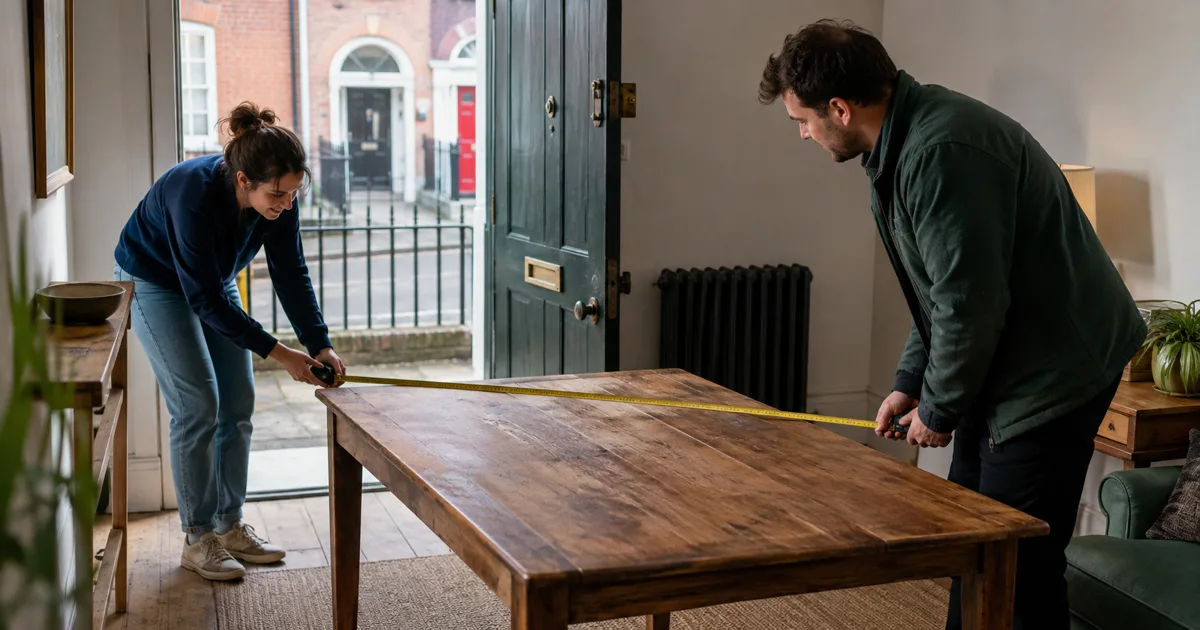
Measure the intended space, but also measure your front door, hallway, stair corners and lift. Mark the furniture footprint with masking tape to see how it affects walking space and doors. For a dining table, include room for chairs to pull out. For a sofa, consider whether removable feet reduce its height and whether the frame can turn through the narrowest point. Do not depend on an estimate such as ‘standard double’ or ‘three-seater’; ask for actual measurements.
How to inspect used furniture
Inspect in good light and compare the piece with the advert. Sit on chairs and sofas with permission, open every drawer and door, and check whether tables rock on a level surface. Look underneath for loose joints, cracked rails, missing fixings, water swelling, woodworm holes or improvised repairs. Smell upholstered furniture for smoke, damp or strong fragrances that could be masking odours. Ask about pets and storage conditions when allergies or hygiene are important.
Extra checks by furniture type
- Sofas: frame movement, sagging support, removable cover condition and access size.
- Tables and chairs: loose joints, splits, wobble, leaf mechanisms and matching seat heights.
- Wardrobes and drawers: back-panel condition, runners, hinges, keys and dismantling points.
- Beds: frame dimensions, slat support, missing hardware and compatibility with your mattress.
- Painted pieces: peeling layers, damp swelling and whether a child-safe finish is documented.
What should second-hand furniture cost in Dublin?
There is no single reliable price list because size, material, maker, age, condition and collection difficulty all matter. Compare several live adverts for genuinely similar pieces. Include van hire, tolls, parking, cleaning, missing fittings and any repair work in the total. Free furniture can be poor value if disposal is the likely outcome, while a sound solid-wood piece can justify more than a damaged item made from lower-cost board. Treat the original retail price as context, not proof of present value.
Upholstery, mattresses and hygiene
Soft furnishings require extra judgement because stains, pests, smoke and moisture may not appear in photographs. Inspect seams, folds, the underside and the area beneath cushions. Ask where the item was stored and do not collect anything showing pest activity or damp. Used mattresses carry particular hygiene and support concerns; many charity shops do not accept them, and a low price does not remove the difficulty of safe disposal if the item proves unsuitable.
Arrange collection without creating new risks
Keep the agreed item, price, condition and collection plan in messages. View in daylight where possible and bring another adult for heavy or valuable furniture. Use blankets and straps, protect walls and floors, and lift within your ability. Inspect before paying. If paying electronically, the seller should confirm the funds in their own account rather than relying on a screenshot. Leave if the furniture, address or behaviour differs materially from the arrangement.
A Dublin furniture-buying shortlist
- For broad local choice: search current Dublin classifieds by item and locality.
- For changing donated stock: check charity shops with dedicated homeware ranges.
- For circular-economy options: consult current reuse and social-enterprise directories.
- For specific periods or restored pieces: compare specialist dealers and their business terms.
- For clearance and auction stock: read fees, condition and collection deadlines before bidding.
Start with the route that matches your budget and transport, then compare across at least one other source. Dublin offers plenty of second-hand furniture, but the best purchase is the piece that fits your home, survives a careful inspection and can be collected safely at a sensible total cost.
Tags
More from
New related stories are added frequently.