
By LocalAds.ie Editorial Team
How to Buy and Sell Bundles of Children’s Clothes in Ireland
Build useful children’s clothing bundles by size and season, disclose every item accurately, check safety details and arrange collection or postage in Ireland.
Published 7 September 2026 - 13 min read
Children can move through sizes before clothes show much wear, which makes bundles one of the most practical parts of the second-hand market. A good bundle saves the buyer time and gives the seller a sensible return without creating dozens of adverts. A bad one mixes sizes, hides stains beneath the best item and costs almost as much to post as it is worth. Clear grouping and a complete inventory solve most of those problems.
Decide whether a bundle is the right format
Bundle ordinary everyday garments that share a useful size, season and purpose. Sell unusually valuable coats, occasionwear, specialist outdoor clothing or new-with-tags pieces separately when buyers will search for them individually. Donate or recycle garments too worn to sell rather than using them to inflate the item count.
Bundles buyers can understand quickly
- A nursery starter set in one stated size range.
- A week of school-free everyday tops and bottoms.
- A winter bundle with jumpers, trousers and one accurately described coat.
- A summer set of shorts, T-shirts and light layers.
- A sleepwear bundle in matching labelled sizes.
- A small mixed-season lot where every item and size is listed.
Avoid combining newborn clothing with toddler sizes, summer shorts with heavy winter wear or pristine pieces with stained play clothes unless the division is explicit. Buyers should not have to zoom into a group photograph and guess what they are purchasing.
Sort by the label, then measure
Children’s sizing varies between brands and garments can shrink. Record every label size rather than assigning the whole pile from the most common item. Separate age ranges, centimetre sizes and letter sizes. Where the fit looks unusual, add useful flat measurements such as chest width, shoulder-to-hem, waist relaxed and inside leg.
State whether measurements are approximate and how they were taken. Do not stretch elastic or round a smaller item up into the next bundle. A buyer may be planning for a growth stage or a particular season, so an inaccurate size can make an otherwise good lot unusable.
Create an exact inventory
Give every garment a simple number and list type, label size, colour, brand if relevant and condition. Count pairs as pairs, not two pieces. If an outfit is coordinated but not an original set, say so. Photograph the full layout, each group and any higher-value or flawed item close up.
Example inventory structure
- Three long-sleeve tops: two size 4–5 years, one smaller-fitting 5–6.
- Two pairs of trousers: labelled 5 years, one with light knee fade.
- One knitted jumper: 110 cm, very good used condition.
- One rain jacket: 5–6 years, hood included, zip tested.
- Two pyjama sets: labelled 5 years, all four matching pieces present.
- Total: nine garments across seven sale items, exactly as photographed.
Inspect in strong natural light
Lay garments flat and examine the front, back, inside and common wear points. Check collars, cuffs, knees, elbows, seat, hems, underarms and waistband. Look for stains, fading, holes, pilling, thinning, stretched elastic, broken stitching, transferred dye and fabric that has become rough or brittle.
Test every zip, popper, button, hook and adjustable waist. Confirm paired items match and that removable belts, hoods or liners are present. Turn pockets inside out and remove receipts, tissues, medication, names and personal objects. Never digitally erase a mark that a buyer needs to assess.
Check cords, drawstrings and small parts
The CCPC warns that cords and drawstrings can become trapped in playground equipment or bicycle wheels. It advises avoiding cords and drawstrings in young children’s clothing, particularly around the hood and neck, trailing below sleeves or hems, or forming long front ties. Inspect every garment against current product-safety guidance before selling or using it.
Check buttons, toggles, beads, sequins, zip pulls and decorative pieces for looseness. A small part that detaches can create a hazard for a young child. Do not make an unsafe garment saleable by tying cords in a knot or attaching an untested part. Follow a manufacturer or recall remedy, or remove the item from the bundle and report a safety concern where appropriate.
Search recalls using exact identity
Look at the CCPC product-safety notices and EU Safety Gate for the brand, product name, style or article number, batch and date where available. Recalls can concern drawstrings, small parts, flammability or chemical risks. Colour and a similar photograph are not enough; compare the permanent labels and notice details precisely.
If an item is recalled, follow the notice. Do not resell it, give it away or describe it as acceptable because your own child wore it without incident. Keep uncertain garments out of the bundle until the manufacturer or responsible authority can identify them.
Treat sleepwear and special-use clothing carefully
Retain all safety and care labels on nightwear, dressing gowns, costumes, waterproofs and other specialist garments. Describe alterations and missing labels. Do not claim flame resistance, waterproofing, UV protection or another performance property unless the label and current condition support it. Washing, age and damage can affect performance.
Do not include used bicycle helmets, buoyancy aids, protective pads or child restraints merely because they are worn on the body. Safety equipment needs separate identity, history, fit and impact checks and may be unsuitable for second-hand purchase. Keep a clothes bundle limited to clothing.
Be cautious with personalised and school clothing
Remove or permanently obscure a child’s full name, school, team, club, address and contact information before photography and handover. Check woven labels, iron-on labels, laundry marker, jacket linings and bag tags. Do not show a readable school crest alongside a child’s size and collection area when it creates unnecessary identification.
A uniform bundle may still be useful locally, but describe it without revealing the former wearer. Follow school rules about crest use and second-hand schemes. Never reuse photographs that show a child modelling the clothes; flat lays or hanger photographs protect privacy and make condition easier to judge.
Wash and prepare without masking condition
Follow each care label and make sure every item is fully dry before storage or packing. Use a neutral approach and disclose persistent smoke, fragrance, pet exposure, damp or a stain treatment that a buyer may need to know. Strong perfume is not evidence of cleanliness and can cause problems for scent-sensitive households.
Remove lint and fold neatly, but do not shave fabric so aggressively that it becomes thin or use filters to brighten whites. Photograph after preparation so the advert represents what will arrive. Store the finished bundle in a clean, dry, sealed container away from smoke, pests and cooking odours.
Take photographs that prove the bundle
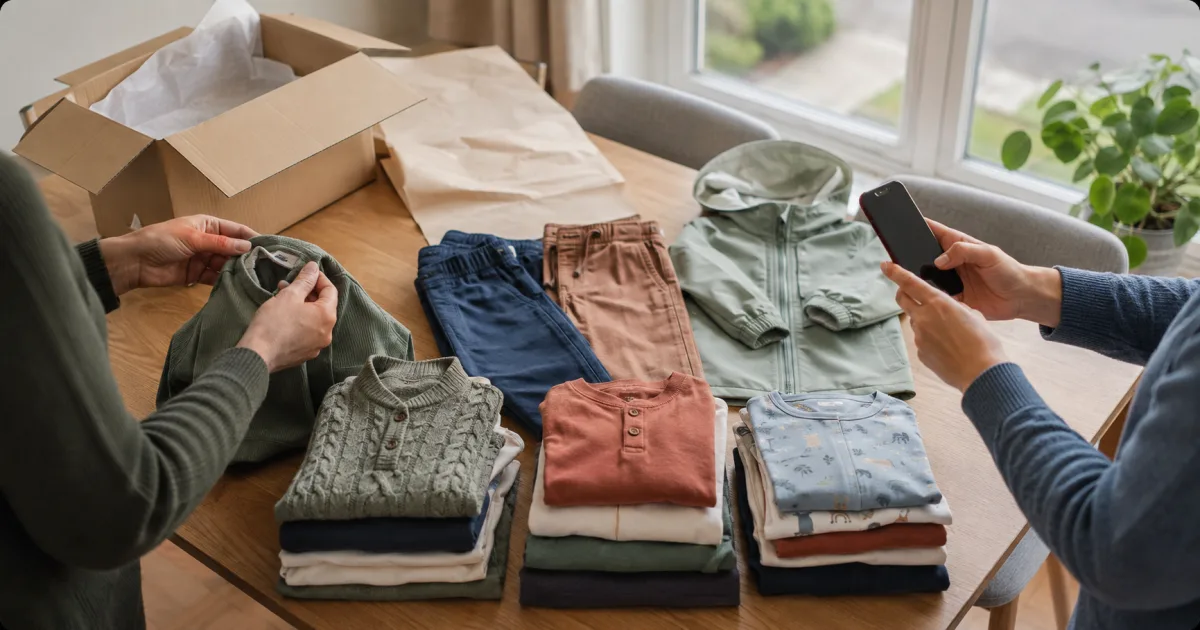
Use indirect daylight and a plain clean background. Start with one photograph of every item laid out without overlap, then photograph logical groups. Add close-ups of labels, fabric texture, fasteners and every flaw. Keep colours realistic and include a simple ruler beside important measurements without covering the garment.
A useful photo sequence
- Complete bundle arranged so the buyer can count every item.
- Tops, bottoms, layers and sleepwear in separate frames.
- Representative size and care labels with personal names hidden.
- Higher-value coat or specialist garment from front and back.
- Every stain, repair, hole, fade or missing component close up.
- Packed bundle on the scales if postage is offered.
Write a description that removes uncertainty
Lead with the dominant size, season, total garment count and collection county. Paste the numbered inventory into the description. State condition item by item, cleaning and storage context, included brands, measurements, faults, whether the home has smoke or pets when relevant, and whether splitting is possible.
Avoid ‘perfect’, ‘like new’ or ‘worn once’ unless the complete bundle justifies the claim. One new top does not make twenty used pieces new. Do not keyword-stuff unrelated sizes or brands. Accurate descriptions attract the household that can use the lot and reduce disputes after postage.
Price the useful pieces, not the pile
Estimate realistic individual second-hand values for saleable pieces, then apply a bundle discount because the buyer accepts the full selection. Ordinary basics usually need a meaningful discount from retail. Condition, exact season, current demand and postage matter more than what the seller originally paid.
Give exceptional items a separate line value, but do not charge for worn filler. Compare current Irish asking prices for genuinely similar lots, not a single designer listing. Set a clear EUR price, whether it is firm, and the exact amount for postage. If the bundle is split later, immediately update the inventory and photographs.
Buyers should calculate cost per usable item
Read the inventory before falling for the headline count. Remove wrong sizes, wrong season, duplicates and pieces whose condition you would not use. Divide the full price plus delivery by the remaining useful garments. A €35 bundle of twenty with only eight suitable pieces costs €4.38 per useful garment, not €1.75.
Questions buyers should ask
- What is the label size of every item and which fit smaller or larger?
- Are all pieces shown in the photographs included?
- Which garments have stains, holes, repairs, pilling or weak elastic?
- Do all zips, buttons, poppers and waist adjusters work?
- Are there cords, loose decorations, recalls or missing safety labels?
- How were items washed and stored, and is there smoke, damp or strong fragrance?
- What are packed dimensions, measured weight and delivery service?
Inspect a local collection efficiently
Agree that the buyer can count and inspect the bundle in daylight without children trying on clothes at the seller’s home. Meet in a safe place, keep messages in the marketplace and bring the inventory. Check the most important garments, labels and disclosed faults, then confirm the count before payment.
Plan postage before publishing
Fold and weigh the complete bundle with its actual packaging. Measure all dimensions and use the current An Post calculator or another carrier’s official terms rather than guessing. An Post classifies items by size, shape, weight and destination; exceeding a limit can move the package into a more expensive category.
State the service, tracking, signature or insurance included and who pays. Standard services may not include compensation, while options and limits change, so check current terms at the time of sending. Never promise next-day arrival as a guarantee unless the selected service provides one and you meet its acceptance deadline.
Pack clothing for Irish weather
Make sure garments are completely dry. Place them in a clean internal water-resistant bag, remove excess air without crushing structured pieces, then use a strong correctly sized outer mailer or box. Seal every opening, protect the address label from rain and keep the carrier receipt and tracking record.
Do not place loose fragrance products, detergent pods or unsealed stain remover in the parcel. Avoid wrapping that transfers ink or dye. Photograph the inventory and sealed parcel before dispatch, but keep names, addresses and tracking numbers private.
Payment and delivery scams still apply
Verify payment only in your own trusted bank or payment application. Screenshots and buyer-forwarded emails are not confirmation. Ignore requests to pay courier insurance, unlock a business account or buy gift cards to receive money. Never share banking passwords, card PINs or one-time codes, and do not follow a payment link sent by the other party.
Private seller or clothing business?
Consumer protections differ by seller status. A private clear-out is generally buyer beware, while a business selling second-hand clothes must meet consumer-law and product-safety obligations. Regular sourcing and resale for profit may indicate trading. Sellers should represent their status honestly; buyers should keep the advert, messages and proof of purchase.
Resolve changes and problems from the written inventory
Before payment, record any agreed split, replacement or price change in the marketplace conversation. On arrival, a buyer should compare the bundle promptly with the inventory and photographs. Separate a genuine undisclosed problem from ordinary wear that was clearly shown. Rights and remedies depend on seller status and the agreement, so evidence matters.
Final seller checklist
- Bundle has one useful size, season or purpose.
- Every item is counted, labelled and graded individually.
- Cords, small parts, labels and recalls have been checked.
- Names, school information and child photographs are removed.
- Garments are clean, completely dry and honestly photographed.
- Price reflects usable pieces and a genuine bundle discount.
- Packed dimensions, weight, service and postage charge are verified.
- Advert and photographs are updated immediately after any split.
Final buyer checklist
- Every listed size and measurement suits the intended child and season.
- Photographs show the complete count and all disclosed flaws.
- No unsafe cord, loose part or recalled item remains.
- Cost per genuinely usable garment is worthwhile.
- Cleaning, storage, smoke, pet and fragrance details are acceptable.
- Collection or tracked delivery terms are written and realistic.
- Payment is independently verified without third-party fees or codes.
- Receipt, advert and messages are kept until the bundle is checked.
The most successful children’s clothing bundle is not the largest. It is the one a buyer can understand in seconds: a truthful size and season, an exact inventory, visible condition and a sensible delivered price. Sellers who remove unsafe and unusable pieces create better value; buyers who calculate only the garments they will actually use avoid false bargains.
Tags
More from
New related stories are added frequently.