
By LocalAds.ie Editorial Team
Buying a Second-Hand Fridge Freezer: What to Check
Check fit, seals, temperature, frost, noise, energy use and transport requirements before buying a second-hand fridge freezer in Ireland.
Published 7 September 2026 - 12 min read
A second-hand fridge freezer has one job that cannot be judged from appearance: it must hold food at appropriate temperatures consistently. A clean interior, working light or cold patch after switch-on does not prove that both compartments regulate correctly over time. Before paying, confirm that the exact model fits your home, inspect its physical condition and ask for enough powered test time to gather meaningful evidence.
Measure the space and ventilation
Measure the installation opening at several points, allowing for skirting, uneven walls and nearby handles. Record maximum width, height and depth, then check the model manual for required ventilation around the sides, rear and top. Restricted airflow can reduce performance and increase energy use. Leave enough room for the doors to open fully so shelves and freezer drawers can be removed for cleaning.
Dimensions to confirm
- Full external width, height and depth, including handles and rear projections.
- Space required for ventilation and safe cable routing.
- Door swing, hinge side and clearance from walls or cabinets.
- Width with doors open enough to remove shelves and drawers.
- Every doorway, gate, stair, landing, lift and vehicle opening on the route.
Check the appliance type too. Integrated, under-counter, freestanding and American-style units need different spaces, fittings, ventilation and services. A plumbed water or ice system adds connection and hygiene questions. Do not assume doors can be reversed or removed for access; verify the exact model instructions and confirm that all required hinge parts are present.
Identify the exact model
Ask for a clear photograph of the rating plate, commonly found inside the cabinet or on the rear, and record the complete model identifier. Use the manufacturer’s official support pages to locate dimensions, capacity, climate class, energy information, manual, spare parts and transport guidance. Similar-looking fridge freezers can differ significantly, so cabinet colour or door layout is not enough.
Search recognised product-recall information with the model and any relevant production identifier. Follow an official manufacturer remedy where one applies. Do not accept a bypass, improvised electrical alteration or claim that a safety notice can be ignored. Avoid exposing a complete serial number publicly where it could be misused, but make sure the identification remains intact and verifiable.
Ask about age, ownership and history
Request the approximate purchase date, original receipt if available and reason for sale. Ask whether the seller bought it new, used or refurbished and whether it served as the household’s main appliance, an occasional overflow unit or equipment in a rental. Long periods in an unheated shed, transport on its side, flooding or repeated power problems can be relevant even when the cabinet now looks clean.
History questions for the seller
- Has either compartment struggled to reach or hold temperature?
- Has food thawed unexpectedly or frozen inside the fridge section?
- Does frost return quickly after defrosting?
- Has the compressor, fan, thermostat, control board, seal or refrigerant system been repaired?
- Are there recurring alarms, error codes, leaks, rattles or clicking sounds?
- How long has the appliance been disconnected, and how was it stored or transported?
Ask what ‘working’ means. A seller may only have seen the light and compressor start, while a meaningful claim should reflect both compartments over a reasonable period. Keep the model, condition, faults, included parts, price and collection details in direct messages. Vague phrases such as ‘probably needs gas’ are not diagnoses and should not be priced as cheap, certain repairs.
Inspect the outside before powering it
With the appliance unplugged, inspect the cabinet, feet, hinges, handles, rear protection and visible connections. Look for severe dents near door alignment, corrosion, impact damage, water staining, oily residue or evidence of an unsafe repair. Check the full visible cable and plug for cuts, crushing, exposed conductors, heat damage or tape. Do not power an appliance with an electrical defect or damaged refrigeration pipework.
Look behind and below where it can be done safely without touching or dismantling components. Heavy dust can reduce airflow, while burn marks, persistent damp or signs of pests deserve caution. Do not scrape frost, bend pipes, remove covers or attempt to find a refrigerant leak during an informal inspection. Refrigeration-system work belongs with a competent service professional.
Inspect doors and seals
Open each door through its complete travel. It should align, remain supported and close without needing to be lifted. Inspect magnetic seals all the way around for tears, hard sections, gaps, mould and loose corners. Clean seals can sometimes be replaced, but price and availability vary. A simple paper-resistance check at several points may reveal an obvious weak area, though it does not certify an airtight seal or correct temperature.
Check the door edge, hinge mounts and cabinet face for distortion. A machine that rocks may need only levelling, but a twisted cabinet or damaged hinge point can prevent reliable sealing. Confirm which way the doors open at the destination and whether a reversible-door kit, blanking plugs or hinge covers are included where needed.
Inspect the interior closely
Inside both compartments
- All shelves, drawers, rails, door bins and retainers are present and stable.
- Liners have no deep cracks, punctures, swelling or poorly sealed repairs.
- Air vents and return paths are not broken or obstructed.
- Lights, switches, displays and controls operate normally.
- Drain channels and accessible outlets are clear and not heavily stained.
- There is no persistent chemical, burning, rotten or severe mould odour.
Missing shelves and drawers affect usable capacity and can be surprisingly expensive to replace. Search exact part numbers before assuming a generic component will fit. Examine freezer drawers for cracks that worsen when cold, and check evaporator covers for damage. Mild cosmetic marks are different from punctures, broken supports or a repair that may affect insulation or airflow.
Look at frost and moisture patterns
Ask the seller not to defrost or switch off the appliance immediately before inspection unless that was agreed. An unusually thick ice sheet, localised frost, water beneath drawers or repeated condensation can point to a door, drain, airflow, defrost or control issue. Some frost is normal in certain manual-defrost models, so compare what you see with the manual rather than applying one rule to every design.
A perfectly dry warm cabinet proves nothing about cooling, while a freshly wiped interior can hide a recurring leak or blocked drain. Ask when it was last defrosted, how quickly frost returns and whether water has appeared on the floor. Never chip ice with a sharp object; puncturing a concealed refrigeration component can destroy the appliance and create a safety concern.
Ask for a meaningful cooling test
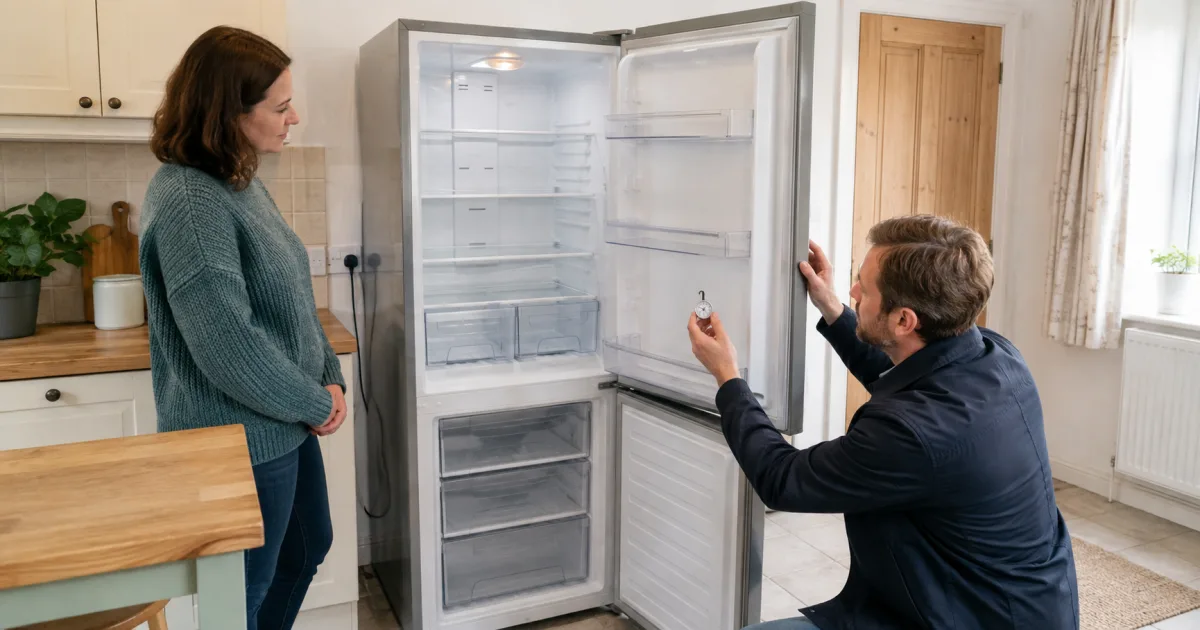
Arrange in advance for the fridge freezer to be empty, clean, connected normally and running long enough to stabilise according to its manual. Use a suitable non-mercury fridge or appliance thermometer rather than judging only by touch or trusting a display without comparison. Do not use the seller’s food as test material, and keep door openings brief so the reading reflects ordinary operation.
The Food Safety Authority of Ireland advises that household fridges should operate between 0°C and 5°C and recommends using a non-mercury thermometer to check the exact temperature. For the freezer, consult the appliance instructions and verify that it reaches the setting needed for frozen-food storage. One reading is evidence, not a guarantee: check both sections and ask whether temperatures remain stable through normal cycling.
During the powered test
- Confirm both compartments cool and controls respond.
- Listen for normal cycling and ask about unfamiliar clicks, buzzes, rattles or fan contact.
- Check that interior lights extinguish when the door switch is operated safely.
- Look for new water, excessive condensation, alarms or error codes.
- Test dispensers only with a clean, correctly connected system and seller permission.
- Allow enough time for a credible result; a brief blast of cold air is not sufficient.
Listen to the compressor and fans
Modern appliances make a range of ordinary operating sounds, including circulation, expansion and fan noise. Focus on repeatable symptoms: a compressor that repeatedly attempts to start, harsh mechanical noise, a fan striking ice, continuous running with poor cooling or severe cabinet vibration. Ask the seller when each sound occurs and compare it with the manual’s troubleshooting information rather than diagnosing by guesswork.
Compare capacity and energy cost
Find the exact model’s official energy label or product information. SEAI explains that the current A-to-G label includes energy consumption and appliance-specific information. For refrigeration, compare annual kWh, chilled and frozen compartment volumes, and noise information—not just the efficiency letter. A larger efficient model may still use more electricity per year than a smaller fridge freezer that meets the household’s needs.
Multiply annual kWh by your own current electricity unit rate to estimate running cost, then compare several years of use. Add delivery, replacement shelves or seals, plumbing parts, professional installation and likely repair. A newer €300 unit that uses less electricity and includes a business guarantee may offer better total value than a €120 private sale with high consumption and missing parts.
Check seller status and terms
The CCPC explains that consumer-law protections apply when a business sells second-hand goods, accounting for disclosed faults and wear. A private consumer-to-consumer sale does not carry the same protection and is generally buyer beware. Ask whether the seller is a business or private person. For a business sale, obtain identity, terms and a receipt and clarify what testing, refurbishment, guarantee, delivery and installation actually include.
Plan transport before paying
Refrigeration appliances require model-specific handling. Read the manufacturer’s transport instructions before collection and ask how the unit was previously moved. Remove loose shelves, drawers and accessories or secure them as directed. Protect doors without applying damaging tape, keep the cable controlled and never lift by handles, doors, pipework or the condenser.
Use enough capable people, an appliance trolley, a suitable vehicle and proper restraint. Keep the fridge freezer in the orientation required by its manufacturer—upright where instructed—and do not improvise because it nearly fits a car. At the destination, position and level it correctly, then wait the manufacturer-specified settling period before switching it on. That period varies with model and transport history, so a universal internet rule is not a substitute for the manual.
Do not transfer food immediately
After installation and the required settling period, allow the empty appliance to reach stable target temperatures and verify them with a suitable thermometer before loading food. Clean it according to the manufacturer’s instructions, check door closure and avoid blocking internal airflow. Keep existing chilled and frozen food in safe alternative storage until the replacement appliance is demonstrably ready.
Reasons to walk away
- The rating plate is missing or model identity conflicts with the advert.
- A recall remains unresolved or an unsafe modification is visible.
- Damaged wiring, pipework, oily residue, burning smell or severe corrosion appears.
- Either compartment cannot demonstrate credible stable cooling.
- Doors do not align or seals have major gaps that cannot be priced confidently.
- Repeated start attempts, alarms, poor cooling or harsh mechanical noise occur.
- The total of energy use, missing parts, transport and repair defeats the saving.
- The seller applies deposit pressure or redirects payment through an unrelated courier link.
Final second-hand fridge-freezer checklist
- Dimensions, door swing, ventilation and access route fit the destination.
- Model, age, history, seller status and recall position are reasonably clear.
- Cable, plug, cabinet, pipework, doors and seals show no unsafe defect.
- Shelves, drawers, controls, lights and required fittings are present and functional.
- Both compartments demonstrate credible temperatures and stable operation.
- Frost, drainage, noise, repairs and known faults are explained in messages.
- Annual energy cost, parts, delivery and installation fit the complete budget.
- Manufacturer transport orientation and settling instructions can be followed.
A good used fridge freezer is the right size, not merely the lowest price. It has a traceable model, sound cabinet and seals, complete storage parts, credible temperature evidence and a transport plan that protects the refrigeration system. If the seller cannot provide that evidence, buying a warmer-looking bargain can cost far more than choosing a better-documented appliance.
Tags
More from
New related stories are added frequently.