
By LocalAds.ie Editorial Team
Buying Second-Hand Gym Equipment for Your Home
Plan a safe home workout space, inspect used weights, benches and cardio machines, verify limits and recalls, and budget for transport and setup.
Published 7 September 2026 - 15 min read
Buying second-hand gym equipment can turn an unused room or garage into a practical training space for much less than new retail prices. The saving only counts when the equipment fits, remains structurally sound and can be installed and used as its manufacturer intended. A rack with an unknown capacity, a treadmill without its emergency stop or a cable machine assembled from mixed parts is not a bargain.
Start with the activity you will repeat
Choose equipment around a realistic routine rather than an impressive collection. The HSE notes that you do not need equipment to be active and recommends beginning at a manageable pace. Decide whether you need adjustable weights, a stable bench, cardiovascular equipment, mobility tools or simply clear floor space. One versatile item used consistently is better value than a room full of machines that block movement.
If you have health concerns, are unsure whether an activity suits you or are recovering from injury, the HSE advises speaking with a GP; stop and seek appropriate advice if exercise causes pain or discomfort. Buying guidance cannot establish medical suitability, teach lifting technique or replace a qualified professional’s individual assessment.
Measure the whole operating space
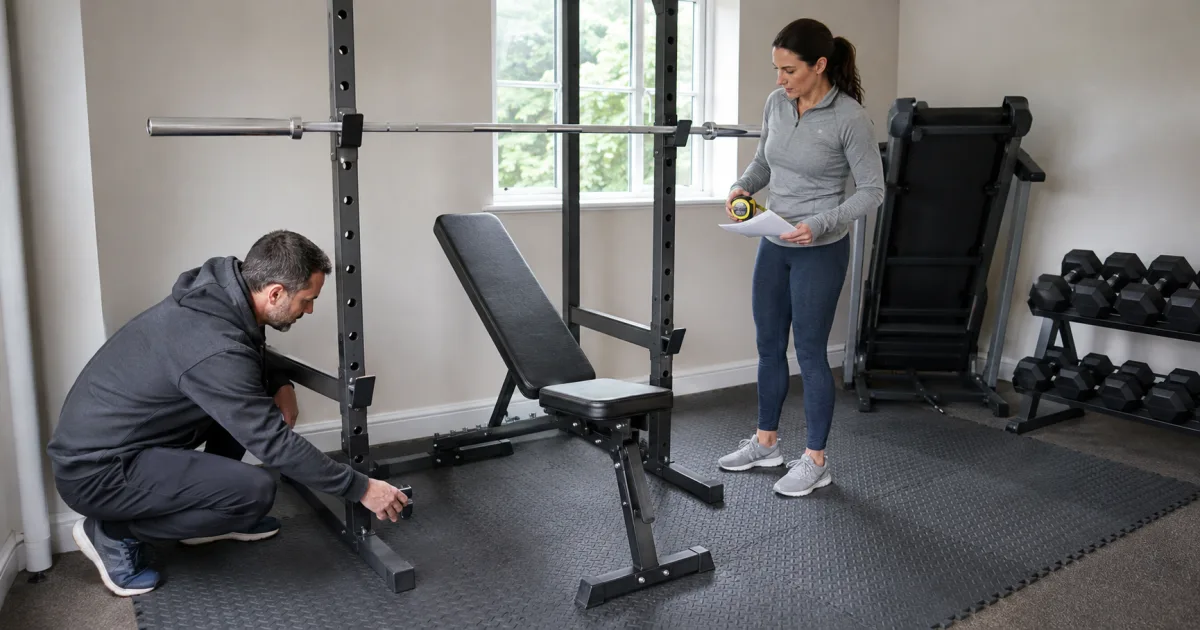
Record room length, width and ceiling height, then add the manufacturer’s required clearances around the exact model. Include the space for a treadmill belt, rowing handle travel, cross-trainer pedals, barbell plates, spotter access, doors, radiators and escape routes. Measure stairs, corners, lifts and door openings between collection and final position.
Check the floor construction, level and permitted load with a competent person when equipment or concentrated weights are substantial. Rubber matting can protect a suitable floor and reduce movement, but it cannot strengthen an inadequate structure or make a sloping surface level. Consider noise and vibration reaching adjoining homes, especially in an apartment.
Plan before searching
- Activity and realistic weekly use.
- Maximum assembled footprint and safe movement clearance.
- Ceiling height through the complete range of motion.
- Floor suitability, levelling and protective surface.
- Socket location, cable route and ventilation for powered equipment.
- Secure storage for plates, dumbbells, pins and accessories.
- Access route and safe delivery method.
Identify the exact model and intended use
Ask for photographs of the model plate, product number, serial number and date code where present. Find the correct manufacturer manual, assembly instructions, parts diagram and user limits. Similar-looking domestic and commercial versions can differ in capacity, dimensions, duty cycle and components. Verify claims from primary documentation instead of copying another seller’s specification.
Confirm the rated maximum user weight and any separate limits for a bench, rack, cable stack, bar, attachment or incline position. A stated total may not apply equally to every configuration. Never assume that thick steel, a large motor or commercial styling proves a capacity. If identity or load rating cannot be established, do not use the equipment for a load that depends on the unknown figure.
Ask about ownership, use and maintenance
- When and where was it bought, and is proof of purchase available?
- Was it used in a private home, shared facility or business?
- Why is it being sold and when was it last used normally?
- Was it stored in a dry heated room, garage, shed or outdoors?
- Which parts were serviced, repaired, replaced or modified?
- What maximum loads and frequency of use did it experience?
- What fault, noise, movement, error or missing part exists?
- Are the correct manual, tools, safety key and all hardware included?
Search safety notices and recalls
Search the exact model, serial range and production date in the CCPC product-safety notices, EU Safety Gate and manufacturer support pages. The CCPC advises comparing identifiers carefully because a recall may affect only particular batches. Follow the stated remedy. Do not resell or buy an affected item on the assumption that a home modification is equivalent to an authorised repair.
Inspect the complete frame before testing
Place equipment on a firm level surface and inspect it unloaded. Look along uprights, crossmembers and welds for bending, cracks, distortion, severe corrosion and drilled or enlarged holes. Pay attention to feet, hinges, attachment points and the areas surrounding bolts. Fresh paint or tape can hide evidence, so ask what was repaired and request earlier photographs where possible.
Compare every fastener with the correct assembly diagram. Check that bolts, washers, spacers, pins, clips, end caps, stabilisers and feet are present and installed in the proper position. A generic bolt that fits the hole may have the wrong length, grade or shoulder. Do not load the equipment until the exact assembly is verified and tightened according to manufacturer instructions.
Racks, stands and benches
Inspect rack hooks, safeties, spotter arms and adjustment holes for deformation, cracks and uneven wear. Both sides should match and lock at the same height. Confirm that every attachment is made for the exact rack series; compatible-looking pins and hole spacing do not establish load capacity. Follow the manufacturer’s anchoring or freestanding requirements at the intended location.
On a bench, check the main frame, feet, back and seat supports, hinges, ladders and locking pins. Set each adjustment while unloaded and confirm that it engages fully without side play. Upholstery tears and compressed foam affect comfort and hygiene, while movement at a support or cracked weld affects safety. Include replacement pads or professional repair in the price.
Bars, plates, dumbbells and kettlebells
Confirm bar length, sleeve diameter, weight and rated load from reliable documentation. Roll an unloaded straight bar on a flat suitable surface or rotate it in secure supports to look for obvious bends; do not perform a loaded test to prove it. Inspect sleeves, collars, centre knurl and end components for movement, corrosion and damage. A bar involved in a serious drop or stored wet deserves extra caution.
Check plates in matching pairs and verify their marked mass, hole size and condition. Cast plates should not have cracks, sharp repairs or loose inserts. Bumper plates should not separate at the hub or show deep splits. Fixed dumbbell heads must be secure; adjustable handles need correct collars or locks. Weigh uncertain items on suitable scales because mismatched pairs can affect training and value.
Plan low, stable storage so round weights cannot roll and heavy plates do not become a trip or crush hazard. Do not stack loose dumbbells on improvised shelves. Keep small pins, collars and resistance accessories away from children and ensure that stored equipment cannot topple if climbed.
Cable machines and multi-gyms
Follow the cable path in the official diagram while the machine is unloaded. Inspect the visible length for broken strands, flattened areas, cracked coating, rust and improvised joins. Check pulleys for chips and wobble, and verify that guards prevent access to moving or trapping points. Pins should be straight, correctly tethered and fully engage the intended weight stack.
Count plates, selector parts, carabiners, chains, handles, shrouds and spacers. Mixed attachments can alter geometry or exceed a connection’s rating. Do not put fingers between plates or tension a damaged cable. A competent technician should replace uncertain load-bearing cables or pulleys with exact approved parts before use.
Treadmill inspection
Verify the rated user weight, motor and supply requirements, speed and incline range, folded dimensions, lubrication schedule and emergency-stop system. HSA gym guidance highlights the importance of an automatic treadmill emergency stop such as a cord attached to the user. Confirm that the correct key and clip are present and that the stop function works exactly as the manual specifies.
With power disconnected, inspect plug, full cable, strain relief, covers, belt edges, deck, rollers, side rails, handrails and folding lock. Look for exposed conductors, taped repairs, melted plastic, belt fraying, misalignment or heavy deck wear. Check that the installation can use a suitable socket and cable route without creating a trip hazard; do not rely on an improvised extension lead.
A demonstration should begin at the lowest speed in a clear area, operated by the seller according to the manual. Listen for knocking, scraping or changing motor pitch, watch belt tracking, test speed and incline progressively, and verify normal stopping plus the emergency stop. Do not step onto a machine whose belt surges, controls fail or electrical condition is uncertain.
Exercise bikes, cross trainers and rowers
Check stabilisers and levelling feet first. On a bike, inspect crank arms, pedals, seat post, handlebar clamps, resistance system and all adjustment pins. Look for side play, slipping and stripped threads. A replacement pedal must match the correct side and thread; do not force one. Confirm that the seat and handlebar ranges fit the intended user.
On a cross trainer, inspect pedal arms, pivots, rails and handles for unequal motion or looseness. On a rower, check the rail, seat rollers, foot restraints, handle, chain or strap and recoil. Water-resistance machines need a sound tank and correct care; air machines need intact guards; magnetic systems need smooth adjustment. Test unloaded functions before a controlled user demonstration.
Electrical and connected features
Inspect powered equipment before plugging it in. Missing earth connection where required, damaged cable, liquid ingress, burning smell, intermittent display or an exposed board requires competent assessment. HSA work-equipment guidance recommends maintenance, pre-use checks and competent repair; the same principles are sensible evidence when evaluating used home equipment.
For app-connected machines, establish which useful functions work without a subscription and whether ownership can be transferred. Ask the seller to remove their account and personal data through the manufacturer’s process. Verify current Irish service availability, software support and subscription cost. A working screen does not guarantee continued access to a closed platform.
Resistance bands, suspension trainers and soft equipment
Elastic products age through time, heat, sunlight, chemicals and repeated stretching. Reject bands with cracks, thinning, tackiness, discolouration, damaged stitching or unknown history; failure can be sudden. Inspect suspension straps, buckles, stitching and anchors against official instructions. Do not attach equipment to a door, ceiling or wall unless the exact system and building structure are suitable.
Mats, pads and upholstered surfaces should be checked for mould, odour, bodily-fluid contamination, peeling, deep splits and degraded foam. Ask what cleaners were used and whether the manufacturer allows them. Some low-value porous items are better bought new when hygiene history cannot be established.
Test without proving the maximum
A marketplace demonstration is not a capacity test. Start with visual inspection and unloaded adjustments, then use a light controlled test within your competence only after all parts are verified. Never place yourself under a bar or machine to test an uncertain catch, cable or weld. For substantial racks, multi-gyms and powered cardio equipment, professional inspection and installation may be the appropriate condition of purchase.
Price parts and repairs before calling it a bargain
Compare several current Irish adverts for the same model, capacity, age and completeness. Asking prices are not evidence of completed sales. Check official or reputable parts availability for belts, decks, cables, pulleys, pins, pads, electronics, safety keys and chargers. A free treadmill can be expensive when it needs a controller and specialist move.
Calculate the full delivered cost
- Equipment and all necessary attachments.
- Missing manufacturer-specific pins, safeties, guards or keys.
- Replacement belts, cables, pads, bearings or electronics.
- Professional electrical, structural or mechanical inspection.
- Floor protection, anchoring and correct installation.
- Dismantling, van hire, stairs, delivery crew and reassembly.
- App subscription and supported-device costs where relevant.
Plan dismantling and collection
Obtain the assembly manual before taking anything apart. Photograph the correctly assembled machine, label matching parts and bag fasteners by step. Never dismantle a loaded cable stack, compressed spring or folding mechanism without the manufacturer procedure and competence. Keep weight plates separate and manageable rather than transporting a machine while loaded.
Gym equipment combines high mass with awkward shapes and poor handholds. The HSA’s manual-handling guidance focuses on assessing load weight, posture, grip, floor quality and route and using mechanical means to avoid or reduce risk. Measure access, clear the path, use suitable equipment and enough competent people, or hire specialist movers. Do not improvise on stairs.
Private seller or fitness-equipment business?
The CCPC explains that consumer protections depend on seller status. Used equipment bought from a business must match its description, be fit for normal purpose and meet the quality reasonably expected for its condition and price. A business cannot pretend to be a private seller to avoid obligations.
A transaction between consumers is generally buyer beware under consumer law. Inspect the actual equipment, preserve the advert and messages, and record model, included parts, disclosed faults, seller status, price and collection arrangement. Do not assume a remaining manufacturer warranty transfers; verify its terms and proof requirements.
Protect payment and personal safety
Keep messages on the marketplace while assessing the sale and do not pay an urgent deposit for equipment you cannot verify. Confirm electronic funds only in your own trusted banking or payment application. Screenshots and forwarded emails are not proof. Never pay courier insurance, an account upgrade or a release fee, and never share a password, PIN or one-time code.
Walk away when the risk stays unknown
- Model, load limit or correct assembly cannot be established.
- Frame, weld, hook, safety arm or bench support is cracked or distorted.
- Essential pin, guard, stop key, shroud or stabiliser is missing.
- Cable has broken strands or an improvised join.
- Power cable, plug or electronics show unsafe damage.
- Treadmill belt surges or emergency stop fails.
- Equipment is recalled without evidence of the authorised remedy.
- Seller refuses inspection or gives inconsistent ownership details.
- Safe removal and reinstallation cannot be planned.
Final second-hand gym equipment checklist
- Equipment matches a realistic activity and available room.
- Operating clearance, ceiling, floor and access are suitable.
- Exact model, capacity, manual and recall status are verified.
- Frame, welds, hardware, feet and adjustments are complete and sound.
- Bars, plates, cables, pulleys and upholstery have been checked.
- Electrical equipment, treadmill belt and emergency stop work safely.
- App ownership, subscriptions and software support are understood.
- No maximum-load or improvised safety test was attempted.
- Repair, installation and delivery are included in the EUR budget.
- Collection uses proper dismantling, handling and transport.
- Seller status, included parts, condition and payment are recorded.
The strongest second-hand home-gym purchase is equipment you can identify, fit into the room, assemble exactly and use within a documented capacity. Condition matters more than the number of attachments. A careful unloaded inspection, controlled demonstration and realistic transport plan protect both the buyer’s budget and the people who will use the space.
Tags
More from
New related stories are added frequently.