
By LocalAds.ie Editorial Team
Buying Used Power Tools: How to Check Condition and Value
Inspect a second-hand power tool safely, assess batteries and essential guards, run a controlled test and calculate its real value before you pay.
Published 7 September 2026 - 14 min read
Buying used power tools can stretch a renovation, trade or hobby budget, but a low asking price is not the same as good value. A drill that needs two batteries, a grinder with the wrong guard or a saw with a damaged base can cost more than a complete working alternative. The useful approach is to identify the exact tool you need, verify ownership, inspect it while isolated from power and agree a controlled demonstration before money changes hands.
Start with the job, not the bargain
Define the materials, hole or blade capacity, working environment and frequency of use before searching. A compact drill-driver may suit furniture assembly but not repeated masonry drilling. A hobby circular saw may be excellent for occasional sheet material yet unsuitable for daily site work. Buying unused capacity wastes money, while an under-specified tool encourages overloading and premature failure.
Write down these requirements
- Tool type and the operations it must perform.
- Material, maximum capacity and expected duty cycle.
- Corded or cordless power source and available voltage.
- Dust extraction, guide, fence or accessory requirements.
- Whether the tool will be used at home, on site or professionally.
- Maximum all-in budget after batteries, consumables and repairs.
Identify the exact model and generation
Ask for a clear photograph of the rating plate and search for the manufacturer’s instructions. Confirm model code, voltage, input power or battery platform, speed range, accessory capacity and the safety components originally supplied. A familiar colour does not prove that two batteries, chargers or accessories are compatible. Model suffixes can identify different voltages, regions or generations.
Check whether the manual, replacement guards, brushes, switches, batteries and chargers remain available. An obsolete professional tool may still be repairable; an inexpensive model with proprietary missing parts may be effectively disposable. Do not rely on a seller’s statement that a universal part will fit where speed rating, mounting dimensions or electrical design matter.
Verify ownership before assessing condition
Portable tools are attractive targets for theft. Ask when and where the seller acquired the tool, why it is being sold and whether a receipt, case, registration record or service invoice supports the story. Compare model and serial details on the tool with any documents. Existing property marks may be legitimate, but the seller should explain them. Walk away from removed plates, ground-off numbers or contradictory accounts.
An Garda Síochána recommends recording serial numbers, photographs, receipts and property markings so recovered belongings can be identified. A buyer can include the model and serial on a private receipt, but neither party should publish the complete serial or residential address in the advert. A credible history is more valuable than a freshly cleaned casing.
Know whether the seller is private or a business
The Competition and Consumer Protection Commission explains that second-hand goods bought from a business carry consumer protections, with age, price and disclosed wear taken into account. A private consumer-to-consumer purchase is generally buyer beware. A trader cannot avoid business obligations merely by presenting regular commercial sales as private, so ask directly and retain the advert, description and messages.
Inspect everything before connecting power
Ask the seller to remove the battery or unplug the lead. Work in good daylight and begin with the casing, fasteners, ventilation slots, handles and controls. Cracks around the gearbox, base, battery rails or handle can reveal impacts. Missing screws, mismatched casing halves, sealant and chewed fasteners may indicate an unrecorded repair. Dust packed into vents can suggest hard use or poor extraction.
General condition checks
- Casing has no cracks, melted areas or loose sections.
- All screws and covers are present and appear appropriate.
- Trigger, lock-off, reverse and speed controls move freely.
- Handles, depth stops, fences and adjustment locks are complete.
- Ventilation openings are clear rather than deliberately covered.
- No strong burning smell, oil leak, water damage or heavy corrosion is present.
- The rating plate is legible and agrees with the seller’s description.
Treat guards and interlocks as essential
The Health and Safety Authority says work equipment should be maintained in good repair and required guards and protection devices should be in place. A missing grinder guard, saw lower guard, side handle, riving knife, lock-off or shield is not cosmetic. Identify what the manufacturer specifies for that exact model. Do not accept improvised guards, bypassed interlocks or a claim that experienced operators remove them.
Move adjustable guards only while the tool is isolated. They should travel through their intended range, lock securely and return as the manual describes. Never place fingers near an edge or spindle to prove movement. If a protection device sticks, has been cut back or needs unavailable parts, treat the tool as needing competent repair rather than discounting the price casually.
Check corded tools and their supply
Inspect the full cable, plug and strain relief without opening the tool. Look for cuts, taped joints, crushed insulation, exposed conductors, bent pins, cracks, loose covers and heat discolouration. Safe Electric advises that damaged electrical appliances should not be used. A test sticker is only a dated record; it cannot compensate for damage that occurred later or prove mechanical condition.
Confirm voltage before any demonstration. Some construction equipment is designed for a 110-volt centre-tapped site supply and should not be connected to an ordinary 230-volt household socket. Never improvise an adapter, replace a fuse with an unsuitable rating or defeat earthing. If you cannot provide the correct supply and supplementary protection, arrange an appropriate professional test.
Assess batteries as separate assets
A cordless tool’s value may sit mostly in its battery packs. Confirm voltage, chemistry, capacity, generation and charger compatibility from official documentation. Inspect each pack separately for cracks, swelling, distorted rails, melted or corroded terminals, leakage and signs of impact or water. Do not charge, test or transport a swollen, leaking, smoking or unusually hot battery.
A charge indicator shows an estimate, not health. Ask the seller to fully charge the pack with the correct charger, then demonstrate a repeatable light task and observe rapid voltage drop, error lights or abnormal heat. Compare packs one at a time. Runtime depends on load and temperature, so a short no-load spin cannot prove capacity. Price a replacement pack before valuing the kit.
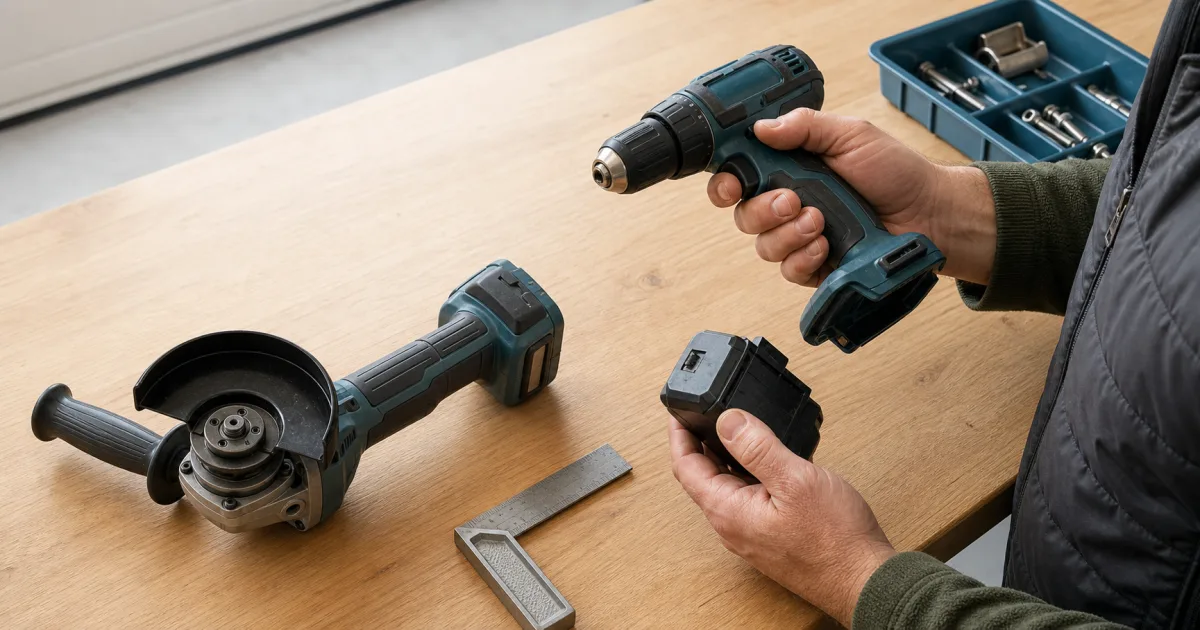
Inspect a used drill or impact driver
With the battery removed, rotate the chuck by hand and check that it opens and closes smoothly. Fit a straight, suitable bit and look for obvious wobble from the side; minor visual movement is not a precision measurement, but severe runout can make accurate work impossible. Check the clutch ring, gear selector, reverse switch, auxiliary handle and depth stop where supplied.
During a controlled demonstration, listen in each gear and test forward, reverse, variable speed and electric brake. The gearbox should not jump out of selection, and the chuck should retain the correct accessory under a modest appropriate load. Hammer action can sound harsh by design, so compare behaviour with the manual or a known sound example rather than diagnosing from noise alone.
Inspect an angle grinder
Keep the grinder isolated and remove any unknown disc. Confirm the correct guard and side handle are present, the spindle lock works only as designed and the flanges are undamaged and appropriate. Check the manual for permitted disc diameter, bore and maximum speed. Never use a disc simply because it physically fits, and never count old, damp, chipped or unidentifiable discs as part of the value.
A seller-led no-load demonstration may reveal difficult starting, erratic control, bearing rumble or severe vibration, but it should use the correct guard and safe setup. Do not ask for an improvised cutting display. Grinding and cutting require appropriate training, workholding and task-specific protective equipment; if those conditions are absent, inspection should stop at safe functions.
Inspect a circular saw
Check the sole plate for distortion with a reliable straight reference and make sure depth and bevel mechanisms move and lock. The lower guard should move freely and return promptly without being tied back. Verify the blade diameter, bore, direction and speed rating against the manual. Check the arbor, flanges, fence, extraction port and riving knife where the model requires one.
A warped base, loose arbor or inaccurate adjustment may matter more than cosmetic scratches. Do not handle a fitted blade unless power is isolated and safe handling is understood. A cutting test needs stable support, correct workholding, the right blade, extraction where required and a competent operator; it is not an appropriate doorstep experiment.
Check other common power tools
Tool-specific points
- Jigsaw: base alignment, blade clamp, guide roller, orbital selector and extraction connection.
- Sander: flat pad, hook-and-loop grip, dust box or port, speed control and bearing noise.
- Router: collet condition, plunge travel, return springs, depth turret, base and fence.
- Planer: sole alignment, cutter guard, depth control, extraction and complete matched blades.
- Multi-tool: accessory mount, locking mechanism, speed control and excessive gearbox play.
- Nailer: model-specific safety contact, magazine, fastener specification and service history; never dry-fire casually.
Plan a controlled demonstration
Agree the demonstration before meeting. The seller should operate the tool in a suitable, uncluttered place using the manufacturer’s instructions, correct guards, secure workholding and appropriate protective equipment. Keep children, loose clothing and bystanders away. The buyer can observe controls, sound and stability without being pressured to perform an unfamiliar operation.
Stop the test immediately if
- The trigger sticks or the tool continues after release.
- There is smoke, a burning smell or abnormal heat.
- The cable, plug, battery or terminals become hot or unstable.
- Vibration is severe or an accessory visibly wobbles.
- The gearbox slips, grinds or jumps out of selection.
- Sparks appear outside normal enclosed brushed-motor behaviour.
- A guard, brake, return spring or interlock fails to operate.
No-load running is useful but limited. It cannot prove battery endurance, torque under work, alignment under load or performance after warming. A very aggressive test can damage equipment or injure people. When the intended use is professional, safety-critical or high-load, budget for inspection and servicing by a competent repairer.
Interpret noise, vibration and smell carefully
Different motor, hammer and gearbox designs have different normal sounds. Seek changes with speed, periodic knocking, scraping, rough coast-down and vibration felt through the body. A brief ozone-like smell may occur around some brushed motors, while persistent burning insulation, smoke or heat is not normal. Do not open a mains tool at a meetup to investigate.
Separate consumables from lasting value
Blades, discs, bits, belts, pads and cutters wear out and can be unsafe when damaged or wrongly specified. Value them at zero unless their identity, condition and compatibility are clear. A clean case is convenient but does not repair a bearing. Conversely, correct guards, handles, fences, chargers and model-specific accessories can have meaningful replacement cost.
Calculate the real second-hand value
Compare several current Irish adverts for the exact model or a genuinely equivalent specification. Asking prices are not completed-sale evidence, so use them as a range. Then compare the current price of a complete new kit and any legitimate refurbished option with warranty. Age alone matters less than working condition, completeness, support and remaining battery life.
All-in cost formula
- Agreed purchase price.
- Replacement batteries and the correct charger.
- Missing guard, handle, fence, case or extraction adapter.
- Fresh suitable consumables.
- Professional inspection, service or repair.
- Collection, insured postage or specialist transport.
- Downtime and the value of any business warranty you give up.
Subtract for untested functions, poor documentation and cosmetic wear only in proportion to their real effect. Do not price around an unsafe defect unless a competent repair route and exact cost are known. If the used total approaches the price of a supported new or refurbished tool, the apparent bargain has disappeared.
Recognise adverts that deserve caution
Warning signs
- Serial or rating plate is removed, altered or deliberately hidden.
- Seller refuses to explain origin or provide a simple receipt.
- Catalogue images replace photographs of the actual tool.
- Essential guards are described as optional or unnecessary.
- Battery damage, taped wiring or improvised switches are minimised.
- Only a payment screenshot or courier collection is offered.
- Price is implausibly low and immediate payment is demanded.
- Seller will not allow a safe visual inspection or defined demonstration.
Arrange collection and payment safely
Meet in daylight in a suitable place, tell someone your plan and keep communication within the marketplace. Confirm everything included before travelling. For bench tools, record dimensions and weight, arrange capable help and use rated restraints; lifting a heavy machine into a car is not a one-person task. Remove batteries and accessories for transport where the manual advises.
Verify payment in your own bank or trusted payment application. A screenshot, buyer-forwarded email or courier message is not confirmation. Never pay an insurance, account-upgrade or release fee to receive money, and never share a card PIN, banking password or one-time code. Record the EUR price, date, seller status, model and serial privately on a receipt.
Know when to repair or recycle
A sound older tool may justify brushes, a bearing or a manufacturer-approved replacement cable fitted by a competent repairer. Cracked structural parts, unavailable guards, serious battery damage or uncertain electrical modifications may make repair uneconomic. Electrical tools, batteries, plugs and cables that have reached end of life belong in an authorised WEEE or battery collection route, not a misleading advert.
Final checklist before paying
- The exact model suits the task, capacity and working environment.
- Seller identity, status and ownership history are credible.
- Rating plate and serial are intact and privately recorded.
- Casing, controls, cable, plug and battery show no unsafe damage.
- Every required guard, handle and interlock is present and functional.
- Battery platform, charger and accessories are officially compatible.
- A controlled seller-led test reveals no serious fault.
- Untested functions and disclosed defects are written down.
- All-in EUR cost remains worthwhile after missing parts and service.
- Collection, payment and receipt arrangements are agreed safely.
A worthwhile used power tool is not merely one that turns on. It is correctly specified, credibly owned, complete with its safety equipment and capable of a controlled demonstration without abnormal behaviour. Inspect the whole working system and calculate the total cost. That discipline helps Irish buyers find genuine value while giving careful sellers a clear way to prove what their equipment is worth.
Tags
More from
New related stories are added frequently.