
By LocalAds.ie Editorial Team
Buying a Second-Hand Pram: Safety and Condition Checks
Check recalls, age suitability, brakes, folding locks, harnesses and structural condition before buying a used pram or pushchair in Ireland.
Published 7 September 2026 - 14 min read
A second-hand pram or pushchair can save a family a substantial amount, but it is safety equipment rather than ordinary furniture. Hidden impact damage, a missing folding lock, an incomplete harness or a recalled model can make a spotless-looking bargain unsuitable. Identify the exact product first, check that it meets the child’s current needs, then inspect every structural and restraint function while the pram is empty.
Clarify which product you need
Pram, pushchair, buggy, stroller and travel system are often used loosely in adverts. Start with the manufacturer’s intended configuration and the child’s age, weight, development and sleeping needs. The HSE says pushchairs and strollers are suitable for newborns only when they recline fully so the baby can lie down. A seat intended for an older child is not made newborn-safe by adding a cushion.
Define the intended use
- Newborn carrycot, lie-flat seat or older-child pushchair configuration.
- Child’s current weight and the manufacturer’s minimum and maximum limits.
- Everyday pavement, public transport, rural path or occasional travel use.
- Single, tandem or sibling arrangement supported by that exact model.
- Car-boot, hallway, lift and doorway dimensions.
- Basket capacity and compatible rain cover without overloading the handle.
Do not mix components because they appear to click together. Carrycots, seats, adapters, car seats and chassis must be explicitly compatible. A complete travel system may still include a child car seat whose history cannot be verified; assess any restraint used in a vehicle separately under current manufacturer and RSA guidance.
Get the identity before arranging a viewing
Ask for the brand, exact model, production or batch details, serial number location and photographs of permanent labels. Request the original instructions or download them from the manufacturer. The manual establishes supported configurations, child limits, folding sequence, harness routing, maintenance and replacement parts. Similar model names can cover several generations with different components.
Check recalls before condition
Search the CCPC product-safety notices, the EU Safety Gate and the manufacturer’s support pages using the exact model, batch and date details. Recall searches must happen before payment and again if identification is unclear. A recall may require immediate discontinued use, a repair kit, replacement part, refund or return; a seller’s statement that the product has always been fine does not cancel the notice.
Compare every character and identifying feature with the notice. Colour alone is not enough. Ask for evidence that any required corrective work was completed by the manufacturer or authorised business. If the label is missing, unreadable or inconsistent, you may be unable to rule out a recall or order the correct parts; that uncertainty is a strong reason not to buy.
Know who is selling
The CCPC explains that consumer protections apply when an Irish business sells second-hand goods, allowing for age, price and disclosed wear. A private consumer-to-consumer purchase is generally buyer beware. A trader cannot present commercial sales as private to avoid obligations, so ask directly when an account repeatedly sells cleaned or refurbished baby equipment.
Keep the advert, photographs and written answers. For a business sale, record the legal seller, model, condition, testing, warranty, delivery and returns. For a private sale, inspect especially carefully and obtain a simple receipt with the date, EUR price, parties, model and serial where appropriate. Keep identifiers private rather than publishing them.
Inspect only while the pram is empty
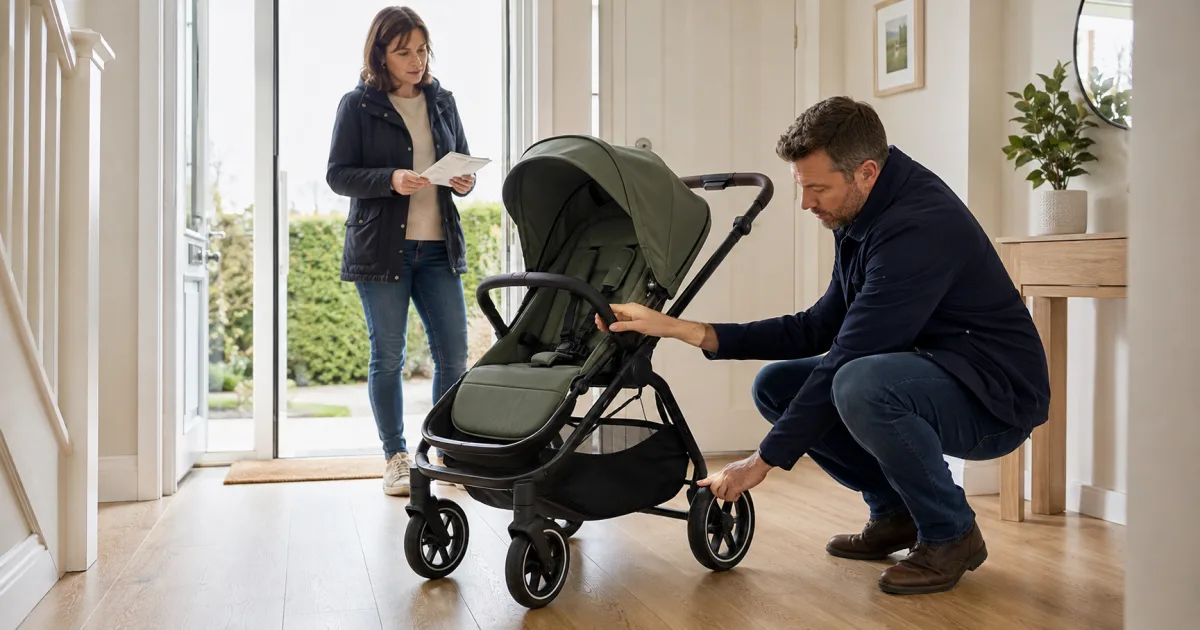
Never place a baby or child in an unverified pram. Work on a flat, dry surface in good daylight. Remove bags, blankets and toys so the frame, seat and basket are visible. Begin with a slow walk around the chassis before operating any joint. Fresh covers, fragrance or a recently wiped frame should not distract from structural evidence.
Follow the frame and every joint
Inspect tubes, welds, rivets, screws, pivot points, axle mounts, handle joints and seat or carrycot attachment points. Look for cracks, bends, distortion, sharp edges, corrosion, loose fasteners, missing caps and mismatched repair hardware. Stress whitening in plastic, a gap around a joint or a frame that no longer sits square can indicate overloading or impact.
Push gently on the empty handle from different directions with the parking brake released. The chassis should feel stable without unexplained movement or clicking. Do not tighten structural fasteners casually at the meetup; some require specified parts, locking compounds and torque. A competent repairer or manufacturer should assess uncertain damage.
Test the folding and unfolding locks
Ask the seller to demonstrate the exact sequence from the manual, then repeat it with the pram empty and fingers clear of pinch points. Every primary and secondary lock should engage positively, and any indicator should show the state described by the manufacturer. The chassis must not begin folding from an ordinary push, lift or handle adjustment.
Check release buttons, catches, cables, springs and hinges for stiffness, damage or improvised repair. A mechanism that requires force may be dirty, bent or incorrectly assembled; a loose one may not secure. Never oil an unknown joint without checking instructions, because lubricant can contaminate brakes, fabric or a part that the manufacturer says must remain dry.
Test the parking brake on a flat surface
Engage the brake as the manual describes and gently try to roll the empty pram forward and backward. It should hold without the pedal releasing, excessive wheel movement or one side remaining free where the design should lock both. Release it and confirm the wheels rotate normally. Repeat several times to expose an intermittent catch.
The HSE advises applying pram or buggy wheel brakes whenever you stop, even on a flat surface. A parking brake is not permission to leave a child unattended or park on a slope. Worn teeth, cracked pedals, bent rods, stretched cables or missing linkages need the correct repair before use, not a promise to be careful.
Inspect wheels, tyres and steering
Lift each end of the empty chassis and rotate the wheels. Look for wobble, cracks, flat spots, loose bearings, damaged spokes where fitted and tyres separating from rims. Confirm each removable wheel locks fully and cannot detach without the intended release. Check that swivel locks operate consistently and that front wheels do not flutter or jam.
Push the empty pram in a straight line, turn both ways and cross a small safe threshold. It should track predictably without a wheel folding under, severe pulling or frame twisting. Air-filled tyres require sound valves and suitable pressure; foam tyres can develop chunks and permanent flats. Price exact replacements before agreeing value.
Check the five-point harness completely
The HSE recommends a five-point harness with all five straps properly secured. Inspect shoulder, waist and crotch straps from buckle to attachment point. Look for cuts, fraying, stretched stitching, heat damage, mould, missing pads and re-threading that conflicts with the manual. Every anchor must attach to the intended reinforced point, not a hole or improvised knot.
Fasten the empty harness and operate the buckle several times. It should latch all required sections, resist a firm controlled pull and release only through the intended action. Adjusters should hold without slipping. Never buy if the buckle opens accidentally, a strap is missing or a generic replacement has been fitted without explicit manufacturer approval.
Inspect the seat, carrycot and recline
Check the seat shell, back support, footrest, side structure and all attachment points. Move the empty seat through every supported recline position and confirm each locks. For a newborn configuration, verify the exact manual requirement for full recline or carrycot use. Do not add pillows, loose cushions or unapproved mattresses; the HSE warns they can create suffocation risk.
A carrycot should have its original firm, flat mattress of the specified dimensions and an intact base, liner, handles and chassis attachments. Do not infer that a pram carrycot is approved for overnight sleep, car travel or use on a separate stand. Only the manufacturer’s instructions for that exact product can establish supported use.
Check canopy, basket and accessories
Open and close the canopy and inspect supports for sharp points, broken hinges and trapping gaps. Ventilation panels should be clear and fabric should not collapse into the occupant space. Check the basket’s stated capacity, stitching and mounts. The HSE advises putting bags in the basket rather than hanging them from the handle, which can tip the pram.
Rain covers must fit the exact configuration, allow ventilation and stay away from the child’s face. Check visibility and attachment without putting a child inside. Footmuffs, boards, cup holders, parasols and sibling seats add leverage and can interfere with folding or stability; accept them only when the manufacturer approves the accessory and the combined limits remain suitable.
Look closely at fabric and hygiene
Smell and inspect both sides of removable and fixed fabrics. Look for mould, mildew, pest evidence, smoke residue, heavy fragrance, bodily-fluid staining and deteriorated foam. Ask how covers were washed and compare with care labels. Hot washing, bleach, solvents or tumble drying can shrink fabric, weaken harness webbing or remove fire and water-resistant treatments.
Cleanliness is important, but it cannot restore degraded straps or foam. Only use manufacturer-approved replacement textiles and mattress parts. If contamination cannot be removed using the documented method, or if the pram has been stored damp, replacement may be safer than attempting to mask the problem.
Test modular attachments one by one
Remove and refit the empty seat or carrycot exactly as instructed. Both sides should engage and any visual indicator should match the manual. Check adapters for the precise part number, orientation and load. A click on one side is not enough. After fitting, apply the manual’s lift or security check without a child present.
Travel-system car seats require separate scrutiny. Unknown collision history, age, missing labels, expiry or service-life limits, absent inserts and incompatible adapters can be decisive. A car seat should never be treated as safe merely because it was bundled with a pram; use current RSA and manufacturer advice for that specific restraint.
Check stability without unsafe improvisation
With the pram empty and configured as instructed, lightly press the handle and sides to assess ordinary stability. Do not hang shopping bags, stand on a ride-on board or add weights to simulate a child. Manufacturer limits and approved test methods exist because improvised loading can damage the product or create a tip.
Confirm parts, service and instructions
Contact the manufacturer or authorised Irish distributor if a structural, brake, buckle or compatibility question remains. Check availability of wheels, brake components, harnesses, adapters and fabrics using the exact serial or model. Avoid unofficial load-bearing, restraint or locking parts. A generic wheel or buckle that fits visually may have the wrong dimensions or strength.
Calculate the complete second-hand cost
Compare current Irish adverts for the same model, production period, configuration and condition, but remember that asking prices are not completed-sale evidence. Compare a current new or professionally refurbished alternative with warranty. A premium chassis without a usable seat, safe harness or supported wheels may be worth less than a simpler complete model.
Add these costs before making an offer
- Manufacturer-approved wheel, brake or handle parts.
- Correct seat, carrycot, mattress, harness or bumper component.
- Approved adapters and rain cover for the actual configuration.
- Professional inspection or authorised repair.
- Replacement fabric that cannot be safely cleaned.
- Collection or protected delivery without hanging weight on the chassis.
- A separate child car seat with verifiable history where needed.
Reasons to stop the purchase
- Model, batch or serial identity is missing or conflicts with the advert.
- A recall applies and required remedy is not documented as complete.
- Frame is cracked, bent, loose or repaired with improvised hardware.
- Folding lock, parking brake, wheel retention or attachment fails repeatedly.
- Five-point harness is incomplete, frayed, misrouted or opens unexpectedly.
- Newborn seat does not fully recline or lacks the specified carrycot setup.
- Mould, smoke, pest contamination or degraded foam cannot be resolved safely.
- Seller refuses an empty inspection, manual check or written receipt.
Arrange collection and payment safely
Measure the folded pram and vehicle opening before collection. Fold it using the instructions, secure loose accessories and protect joints during transport. Never use an unverified second-hand car seat to transport a child home. Meet in daylight, retain marketplace messages and verify payment through your own bank or trusted application rather than a screenshot or seller-provided link.
Complete setup before the first outing
At home, download and read the complete manual, register the product with the manufacturer where possible and recheck current recalls. Clean only as instructed. Reassemble each part carefully, perform the empty brake, lock, wheel, harness and attachment checks, and arrange qualified repair before use if anything remains uncertain.
When the pram is ready, use the harness every time, apply the brake whenever stopped and keep hold of the handle. Put bags in the rated basket, not over the handle; never attach a dog lead. Keep pillows and loose cushions out, and move a sleeping baby from a seated position to an appropriate flat sleep surface as HSE guidance advises.
Final second-hand pram checklist
- Exact model, batch and instructions are identified.
- CCPC, EU Safety Gate and manufacturer recall searches are clear.
- Configuration and limits suit the child’s current age, weight and needs.
- Frame, joints, handle and attachment points are structurally sound.
- Folding locks and parking brake engage reliably every time.
- All wheels retain, rotate and steer without serious fault.
- Complete five-point harness latches, adjusts and anchors correctly.
- Seat or carrycot recline and newborn suitability match the manual.
- Fabrics, mattress, canopy and basket are cleanable and undamaged.
- Approved missing parts, inspection, collection and car seat are included in total cost.
A safe used pram is one you can identify precisely and verify against recalls, instructions and every essential function. Cosmetic freshness is secondary to a sound chassis, reliable locks, effective brake, retained wheels and complete five-point harness. Inspect it empty, reject improvised repairs and calculate the cost of an approved, complete setup before paying.
Tags
More from
New related stories are added frequently.