
By Local Ads Editorial Team · Irish Marketplace Guides
Buying a Second-Hand Electric Bike in Ireland: Battery, Motor and Safety Checks
Check battery health, charger, motor assistance, frame, brakes, ownership and real replacement costs before buying a used e-bike.
Published 11 August 2026 · Reviewed 20 August 2026 · 12 min read
A used electric bike combines an ordinary bicycle with an expensive battery, motor, controller and charger. Cosmetic condition tells only part of the story. A worn drivetrain can be repaired predictably; a proprietary battery near the end of its life may change the entire value. Confirm that the bike is a road-legal type for your intended use under current Irish rules and seek specialist advice where power, speed, throttle operation or modification is unclear. Never charge or test a visibly damaged lithium battery.
Identify the complete electrical system
Record the bike, motor, display, battery and charger brands and model references. Confirm that components belong together and have not been altered with unsupported firmware or adapters. Ask the seller about age, storage, typical range, charging pattern and any error codes. Range claims vary with rider, weather, terrain and assistance level, so they are not a battery-health measurement. Check whether a compatible replacement battery and authorised service are actually available in Ireland.
Electrical identity
- Battery voltage, capacity, model and key availability.
- Original or manufacturer-approved charger with an intact cable and plug.
- Motor type, display operation and assistance controls.
- Any diagnostic report, cycle count or service record available.
- Current replacement cost and supply for proprietary components.
Inspect the battery before any charge
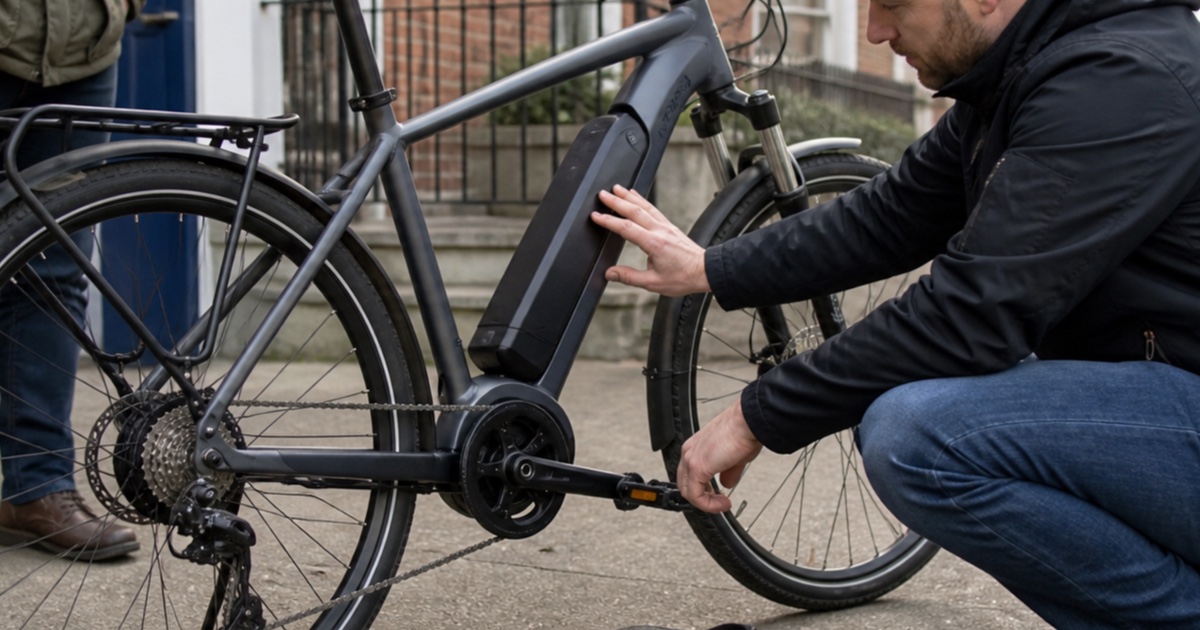
Look for swelling, cracks, impact damage, corrosion, unusual heat, odour or improvised repairs. Check that the battery locks securely and contacts are clean and undamaged. Do not open the pack. If damage is suspected, stop and ask a qualified e-bike or battery specialist. A short display reading can be misleading because voltage may fall sharply under load. Where possible, obtain a diagnostic health report or complete a meaningful test ride from a known charge level.
Battery red flags
- Swollen casing, cracked mounts or evidence of water entry.
- Charger, connector or cells that become unusually hot.
- A replacement charger with uncertain voltage or connector adaptation.
- Sudden display drops, assistance cut-outs or charging errors.
- Seller refuses to explain storage, age or why the original charger is missing.
Inspect it as a bicycle
The electrical system does not reduce the importance of frame, fork, wheels, tyres, brakes and drivetrain. E-bikes are heavier and may wear brakes and chains faster, particularly under hills or cargo. Check frame welds and high-load areas for cracks or suspicious repainting. Spin both wheels, test spoke tension broadly and inspect tyre condition. Confirm that brake performance is appropriate for the bike and that replacement pads, discs and drivetrain parts are available.
Mechanical checklist
- Frame and fork free from cracks, severe corrosion or crash distortion.
- Wheels run true and bearings turn without roughness or play.
- Brakes engage firmly and friction parts have service life remaining.
- Chain, cassette and chainring do not skip under motor load.
- Lights, rack, mudguards and fasteners are secure.
Test every assistance level
Arrange a safe test ride only with the seller's permission and suitable insurance or legal cover. Begin without assistance to feel the bicycle, then use each supported level under moderate load. Listen for grinding, clicking or bearing noise and watch for display errors. Test cut-off behaviour when pedalling stops and when braking if brake sensors are fitted. Avoid unsafe speed tests. A legal classification concern or modified controller should be resolved before purchase, not accepted on a promise.
Test-ride observations
- Smooth, predictable engagement rather than surging.
- Assistance remains stable on a modest climb.
- Display, controls and remaining-charge indication behave consistently.
- Motor and battery remain free from abnormal heat or noise.
- Bike stops safely and handles securely with its additional weight.
Verify ownership and total value
Ask for proof of purchase, frame number and keys, and check whether the bike has been reported stolen through appropriate available channels. Be cautious with removed serial labels, incompatible chargers or a price far below plausible component value. Add likely battery, drivetrain and brake replacement to the price. Local Ads helps sellers disclose condition and buyers compare nearby e-bikes, but ownership, legality and mechanical safety remain matters for the parties and relevant experts.
Before paying
- Record the frame number and match it to available documents.
- Confirm every battery and lock key is included.
- Price a genuine compatible battery rather than a risky unknown substitute.
- Ask an e-bike specialist to inspect high-value or modified bikes.
- Use a written receipt describing the bike, frame number, date and parties.
The practical takeaway
The battery is often the largest uncertainty, but the safest decision considers the whole bike. Identify every component, reject damaged charging equipment, test assistance under realistic load and verify ownership. A professional diagnostic can turn a vague range claim into useful evidence. If replacement parts or legal classification cannot be established, the apparent bargain may be impossible to use safely or economically.
Tags
More from Buyer safety
7 min read
Buying and Selling Second-Hand Baby Items in Ireland: A Safety Guide
A careful guide to listing and buying used prams, cots, highchairs, toys and baby equipment in Ireland, with safety-first checks.
 Buyer safety
10 min read
Free Stuff in Ireland: How to Give Away and Collect Items Safely
A practical guide to giving away usable items and arranging free local collections without creating unnecessary safety or privacy risks.
 Buyer safety
10 min read
How to choose a local tradesperson in Ireland
Compare qualifications, references, written quotes, insurance and payment stages before hiring someone for work in your home.