
By LocalAds.ie Editorial Team
Buying Second-Hand Garden Furniture: What to Look For
Inspect used garden tables, chairs, benches, cushions and parasols for weather damage, stability and missing parts before arranging collection in Ireland.
Published 7 September 2026 - 15 min read
Buying second-hand garden furniture can deliver a stronger table, a larger set or better materials for less than buying new. Outdoor furniture also carries a particular kind of uncertainty: rain, frost, ultraviolet light, soil contact and poor winter storage can weaken an item long before the damage looks dramatic. A good inspection separates harmless weathering from structural deterioration and includes the true cost of cleaning, repair and collection.
Start with the space, not the advert
Measure the usable patio, balcony or garden surface before searching. Record the maximum table footprint and the extra clearance needed to pull out every chair, walk behind seated people and open doors or gates. A six-seat set may technically fit the paving while making the route to the house unusable. Check whether the ground is level and whether chair legs could sink into gravel or soft grass.
Decide how the furniture will actually be used. Regular outdoor meals call for a stable table at a comfortable height; occasional extra seating may favour folding chairs; a small exposed balcony needs secure, compact pieces rather than a light parasol. If children use the space, look particularly closely at folding mechanisms, glass, sharp corners and climbable or unstable designs.
Confirm exactly what the sale includes
Count the table, chairs, bench, cushions, cover, parasol, base, fixing hardware and any extension leaves. Ask whether every object in the photographs is included and whether anything has changed since the advert was posted. Matching furniture may have been assembled from different sets, so compare dimensions, colour, joints and hardware instead of assuming that similar-looking chairs share the same age or condition.
Details to request before travelling
- A current photograph of the complete set on a level surface.
- Close views of each chair joint, table underside, feet and fixings.
- Material, approximate age, brand or model where known.
- Outdoor exposure and where the set was stored each winter.
- Every repair, crack, loose joint, stain, rust patch or missing component.
- Table, chair and packed dimensions, including the longest non-removable section.
- Whether the furniture dismantles and which tools or instructions are available.
Inspect in daylight and while the furniture is dry
Wet timber and dark photographs can hide discolouration, fine cracks and uneven finish. Arrange to see the furniture dry, clean enough to inspect and in natural light. If it has just rained, look under the tabletop, inside joints and beneath cushions, but do not assume a dark wet patch proves rot. Ask to return or request detailed dry photographs when the surface cannot be assessed fairly.
Begin with a slow complete walk-around. Compare all legs, armrests, rails and slats. Look for leaning frames, unequal gaps, replaced fasteners and one component sitting differently from the rest. Smell can reveal damp storage, mould, smoke or animal contamination that a photograph cannot show. Stop if sharp edges, unstable structures or broken glass make handling unsafe.
How to check wooden garden furniture
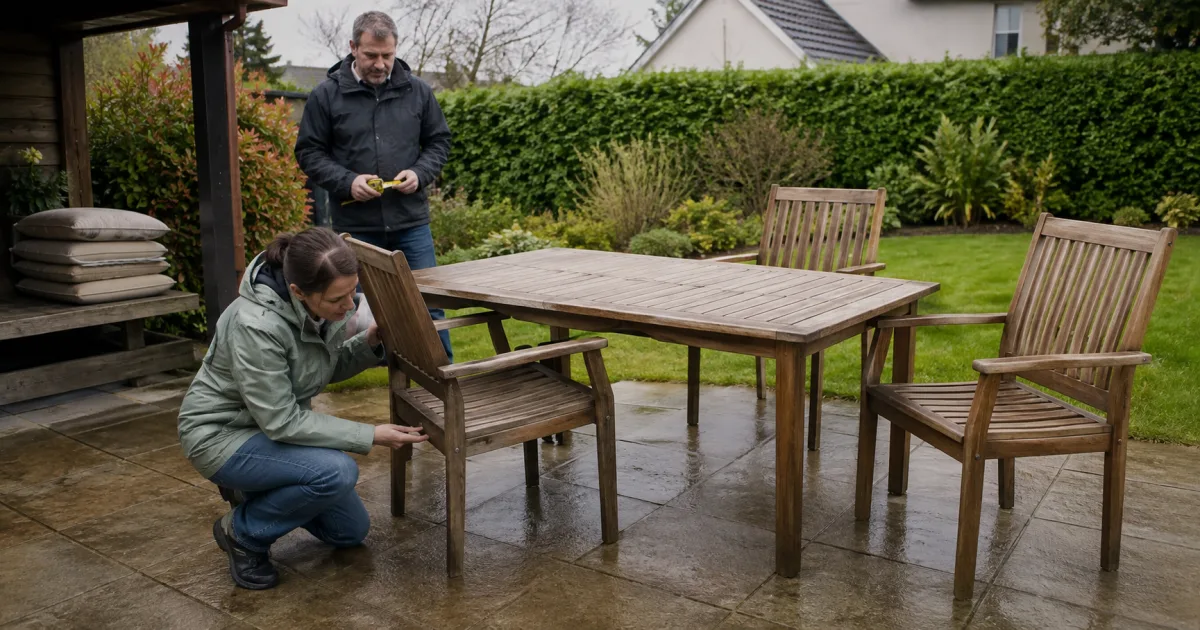
Silver-grey colour on some outdoor timber can be cosmetic weathering rather than failure. The more important evidence is texture and strength. Pay attention to end grain, feet, the underside of horizontal rails, screw holes and places where water can sit. Probe only with the seller’s permission and without damaging the item. Timber that feels soft, crumbles, flakes deeply or compresses around a joint may have decay rather than surface ageing.
Inspect every mortise, dowel, bolt and glued joint. Fine surface checking can occur as wood dries, while a crack running through a load-bearing rail or fastener hole can reduce strength. Rock the empty chair gently on a flat surface and watch the joints rather than forcing them. A loose bolt may be simple to tighten; movement caused by split timber, failed glue or enlarged holes can require skilled repair.
Ask what wood and finish were used, but treat an unsupported species claim cautiously. Teak, eucalyptus, acacia and softwood behave differently and command different prices. Look for manufacturer information or original documents when the price depends on the material. Include cleaning, sanding, suitable outdoor finish, replacement timber and your time in the cost; a cheap set needing complete refinishing may not be the cheaper choice.
How to check steel, iron and aluminium
On steel or iron, distinguish light surface rust from deep scaling, holes and loss of metal around welds or fasteners. Inspect the underside, tube ends, feet and any place that traps water. Bubbling powder coat may conceal corrosion. A cosmetic patch can often be prepared and refinished, but thinning legs, cracked welds and movement around load-bearing joints need proper assessment and may make the item unsuitable.
Aluminium does not develop red iron rust, but it can oxidise, pit or crack. Inspect welds, cast connectors and mixed-metal fasteners. White deposits, swollen joints or seized bolts can indicate corrosion. Check that protective foot caps remain in place; missing caps can admit water, expose sharp tube edges and damage paving. Never rely on fresh paint as proof that the metal beneath is sound.
Inspect synthetic rattan and resin weave
Run your eyes across the weave for snapped strands, cracks, loose ends, fading and sections that have become chalky or brittle from sunlight. Press very lightly on a discreet strand with permission; do not pull or bend ageing plastic aggressively. A few replaceable loose ends differ from widespread embrittlement, which can continue breaking during transport and normal use.
Look beneath the weave at the hidden metal frame. Check welds, corrosion, feet and the points where strands attach. The exterior can appear tidy while the supporting frame has deteriorated. Confirm whether the set is sold as weather-resistant rather than waterproof and ask how it was covered or stored; marketing language from years ago does not prove present condition.
Check moulded plastic carefully
Plastic furniture should retain a consistent shape and some resilience. Avoid chairs with structural cracks, sharp fragments, warped legs or strong stress whitening around joints and fasteners. Extensive chalking and brittleness suggest ultraviolet ageing. Cosmetic fading may be acceptable at the right price, but paint or dressing cannot restore strength to degraded plastic.
Treat glass tabletops as a separate safety decision
Identify whether the glass belongs to the original table and look for a permanent safety or manufacturer marking where present. Inspect every edge, corner and fixing hole in strong light. Chips, deep scratches, impact marks, cracks and damaged edges are reasons to walk away rather than plan a casual repair. Do not place weight on the glass as a test.
Check that the frame is level and that all correct pads, clips, stops and fasteners support the top without metal-to-glass contact. Ask how the glass must be removed and transported. Carry it using an appropriate method, keep it protected and upright as recommended by the manufacturer or a competent glass supplier, and never improvise when its type, condition or safe handling is uncertain.
Test chairs, benches and reclining mechanisms
Place each chair empty on a level, firm surface. Compare whether all feet touch, then apply light hand pressure to detect rocking and watch the frame for independent joint movement. Test only as the furniture was designed to operate. With the seller’s agreement, sit carefully only after the visual and joint checks are satisfactory; do not bounce, stand on a chair or use excessive force to prove a fault.
Operate folding or reclining parts slowly with hands clear of pinch points. Confirm that locks engage, backrests hold consistently and hinges are neither distorted nor missing retainers. Check armrests and bench centres for flex, and examine underneath for improvised brackets, protruding screws or repairs. A mechanism that occasionally catches may become dangerous in ordinary use.
Cushions can change the value of the set
Remove every cushion and inspect both sides, seams, ties, zips and foam. Look and smell for mould, damp, staining, sun damage, pests and degraded filling. A clean cover does not prove that the foam is dry. Ask whether covers are removable and follow their care labels. Price replacements before buying because unusual shapes can cost more than refinishing the frames.
Do not accept a claim that ordinary fabric is waterproof without reliable product information. Plan dry, ventilated storage even for outdoor-rated cushions, following the manufacturer’s directions. If contamination is extensive or the filling cannot be cleaned and dried safely, value the sale as frames only and agree that the unwanted cushions will not be transferred.
Inspect parasols, canopies and bases
Open a parasol only when conditions are calm and there is safe clearance. Check canopy seams, ribs, crank, tilt mechanism, pin and pole for tears, bending, corrosion and trapping points. Confirm the base is included and suitable for that exact parasol and setting. A heavy-looking base is not automatically adequate, especially for a cantilever design.
Wind can overturn or lift outdoor furniture. Follow the original manufacturer’s instructions for base weight, anchoring, closing and storage, and close the parasol when it is unattended or conditions require it. If model instructions and compatible parts cannot be identified, do not invent an anchoring arrangement from loose weights or improvised ties.
Look for missing hardware and unavailable spare parts
Compare all repeated positions across the set. One chair may reveal the cap, spacer, washer or brace missing from another. Ask for original bolts, keys, extension mechanisms and assembly instructions. Generic fasteners are not always suitable: length, thread, head, corrosion resistance and strength matter, particularly in folding and load-bearing connections.
Search the exact model for replacement components before paying, without assuming that a similarly named current range is compatible. If identity is unknown, photograph and measure the required part but budget conservatively. An incomplete table is valuable only if the missing component can be sourced or competently made.
Check for recalls and product warnings
Use the manufacturer, model and batch details to search the CCPC product-safety notices, the EU Safety Gate and the manufacturer’s own notices. Compare identifiers precisely; appearance alone is not enough. Follow any recall instruction and do not buy a recalled product on the promise that it can simply be tightened or altered at home.
Irish government guidance says products sold in Ireland must be safe. A private buyer should still make an independent safety decision because an old item’s history, instructions and labels may be incomplete. If a structural repair, unknown glass top or unstable mechanism needs expert judgement, arrange that assessment before use rather than relying on a low price.
Ask about storage and maintenance history
Furniture stored dry under cover may age very differently from the same model left on soil through several winters. Ask whether it was kept indoors, in a shed, beneath a breathable cover or continuously outside; whether feet stood in water; and what cleaners, oils, paints or preservatives were applied. Photographs from earlier seasons can support the history but should not replace current condition images.
Be cautious when a fresh coating prevents inspection. New oil can make timber temporarily darker, while thick paint can cover cracks or corrosion. That does not mean every refinished item is problematic: ask what preparation and product were used, when the work was completed and whether photographs show the surface beforehand.
Calculate value from the complete usable set
Compare current Irish listings for the same material, seating capacity, condition and included accessories. Asking price is not proof of sale value, so use several close examples. Start with the value of a sound complete set, then subtract realistic costs for cushions, fixings, treatment, transport and professional repairs. Do not pay a premium for an unverified brand or timber species.
Costs commonly missed
- Replacement cushions or made-to-measure covers.
- Outdoor cleaner, rust treatment, primer, paint, oil or preservative.
- Correct corrosion-resistant fixings and manufacturer-specific parts.
- Van hire, fuel, tolls and a second capable person for handling.
- Safe glass transport or specialist assistance.
- Dry storage or a suitable fitted cover after purchase.
Measure collection access before agreeing
Record the tabletop’s length, width and thickness, chair height and width, and every component that does not dismantle. Measure your vehicle opening and internal load space, not just the exterior. Check gates, side passages, steps, apartment lifts and parking distance at both addresses. Ask which sections separate and whether old fixings can be removed without damage.
Plan the load before collection. Heavy or awkward furniture creates risk through weight, poor grip, reaching and twisting. The HSA’s manual-handling guidance emphasises assessing the full task and risk factors rather than treating training as a complete solution. Use enough capable help and appropriate handling equipment, clear the route, divide the load where designed, and use a professional service when the job exceeds your ability.
Protect furniture and people in transit
Remove cushions, loose glass, leaves and detachable hardware before moving. Bag and label fasteners for their exact positions. Protect corners and finished surfaces with clean padding, but do not wrap damp timber tightly for long storage. Secure the load using appropriate vehicle anchor points and restraints; never let furniture obstruct the driver, exceed the vehicle’s limits or project unsafely.
Know whether the seller is private or a business
The CCPC explains that rights depend on who sells the second-hand item. Goods bought from a business must meet consumer-law requirements, including matching the description and being fit for their normal purpose, with quality considered in light of their used condition and price. A trader cannot pretend to be a private individual to avoid those obligations.
A purchase from another consumer is generally buyer beware under consumer law, making your inspection and written agreement especially important. Check the seller status displayed on the marketplace. Save the advert, photographs, messages and payment record, and make sure faults, included parts, collection timing and any condition of the sale are confirmed before money changes hands.
Keep collection and payment safe
Keep initial messages within the marketplace and share only the information needed to arrange collection. Do not publish a home address. If collection is from a residence because the item is bulky, tell someone your plan, avoid carrying cash unnecessarily and keep the handover area appropriate. Inspect the actual furniture before final payment rather than relying on old photographs.
Verify electronic payment in your own trusted banking or payment application. A screenshot, buyer-forwarded email or courier page is not confirmation. Never pay insurance, an account upgrade, a release charge or a courier collection fee merely to receive money, and never share passwords, card PINs or one-time codes.
Walk away from structural uncertainty
Surface fading, a removable stain or a finish due for renewal can be a fair project when priced honestly. Deep decay, cracked load-bearing members, perforated corrosion, brittle plastic, broken recliner locks, damaged glass and unexplained major repairs are different. If you cannot establish that the item can be used safely and repaired economically, leave it rather than allowing sunk travel time to drive the decision.
Final garden furniture buyer checklist
- Set and chair clearance fit the intended space.
- Every included frame, cushion, cover, parasol and fitting is counted.
- Furniture has been inspected dry in useful daylight.
- Timber, metal, plastic or weave is structurally sound rather than merely refinished.
- Every chair, bench, hinge and lock is stable on a level surface.
- Glass has no chip, crack or unsafe missing support.
- Model and batch have been checked against relevant safety notices.
- Replacement parts, restoration and storage costs fit the budget.
- Vehicle, access, helpers and restraints are suitable for collection.
- Seller status, faults, price and included parts are recorded in writing.
- Payment is independently verified without links, fees or security codes.
The best second-hand garden furniture purchase is not necessarily the set with the freshest finish. It is the one whose size suits the space, whose frame and moving parts remain sound, whose weather history makes sense and whose complete delivered cost still represents value. Inspect methodically and be willing to leave unsafe uncertainty behind.
Tags
More from
New related stories are added frequently.