
By LocalAds.ie Editorial Team
Buying a Used Lawn Mower: Questions to Ask Before You Buy
Choose the right used mower for an Irish garden, verify its identity and service history, inspect guards and controls, and arrange a safe supervised demonstration.
Published 7 September 2026 - 16 min read
A used lawn mower can be excellent value when its size, power source and condition suit the garden. It can also hide expensive faults or missing safety parts behind a clean deck. The safest approach is to identify the exact machine, ask for its history, inspect it completely while isolated from power and then watch a controlled demonstration by the seller. Never reach beneath a mower or defeat a control to complete a purchase.
Choose the mower type before comparing prices
Measure the lawn and note slopes, narrow gates, trees, borders, rough patches and distance from a safe power socket. A compact push mower can suit a small level plot; a wider self-propelled model may reduce effort on a larger lawn but costs more to maintain. Mains-electric machines depend on cable reach and careful routing, while battery models depend on battery condition and replacement cost.
Petrol mowers offer independence from a cable but add fuel, oil, noise, exhaust and servicing. Robotic mowers need a compatible charging station, installation method, security access and a garden they can navigate. Ride-on mowers are a separate machinery purchase with additional steering, braking, deck, tyre and transport risks; consider a competent dealer inspection rather than treating one as an enlarged pedestrian mower.
Match these specifications to the garden
- Power source: manual reel, mains electric, battery, petrol or robotic.
- Cutting width and minimum-to-maximum height range.
- Push or self-propelled drive and available speed settings.
- Collection, rear discharge, side discharge or mulching capability.
- Garden slope and the model-specific permitted operating angle.
- Machine weight, handle adjustability and storage dimensions.
- Noise, maintenance, cable routing and charging requirements.
Identify the exact machine
Ask for clear photographs of the manufacturer plate, exact model, product or article number, serial number and year or date code where present. On petrol equipment, identify both the mower and the engine because parts and service information may be separate. Search the manufacturer’s Irish or European support site for the correct operator manual, parts diagrams and current notices before travelling.
The identity should agree across the machine, receipt, manual, charger and seller’s description. Do not publish a serial number in an advert or public message; exchange the minimum detail privately for checks. A removed or altered identifier, unexplained ownership history or mismatched charger deserves caution. Keep evidence of the agreed model and included equipment.
Questions to ask the seller first
- How long have you owned it, and why are you selling?
- Was it bought new or used, and is there proof of purchase?
- When did it last cut grass normally?
- What garden size, slope and conditions was it used on?
- How was it cleaned and stored between cuts and over winter?
- What servicing, repairs and replacement parts has it had?
- Does every original safety control work without modification?
- What fault, leak, unusual vibration, noise or starting problem exists?
- Which collector, battery, charger, key, cable and accessories are included?
- May I see a cold start and a short controlled cutting demonstration?
Check recalls and safety information
Search the exact model and production identifiers in the CCPC product-safety notices, EU Safety Gate and manufacturer support pages. Compare dates, serial ranges and remedy instructions rather than relying on a similar photograph. If a notice applies, follow it. Do not buy on the promise that a recalled part can be improvised or that years of incident-free use prove the machine safe.
Read the correct operator manual before any demonstration. Controls, isolation steps, slope limits, protective equipment, fuel requirements and maintenance methods differ by model. The HSA advises that machinery should not be used without guards in place. A missing discharge flap, collector interlock, belt cover, cable restraint or operator-presence control is not a cosmetic omission.
Inspect only when power is isolated
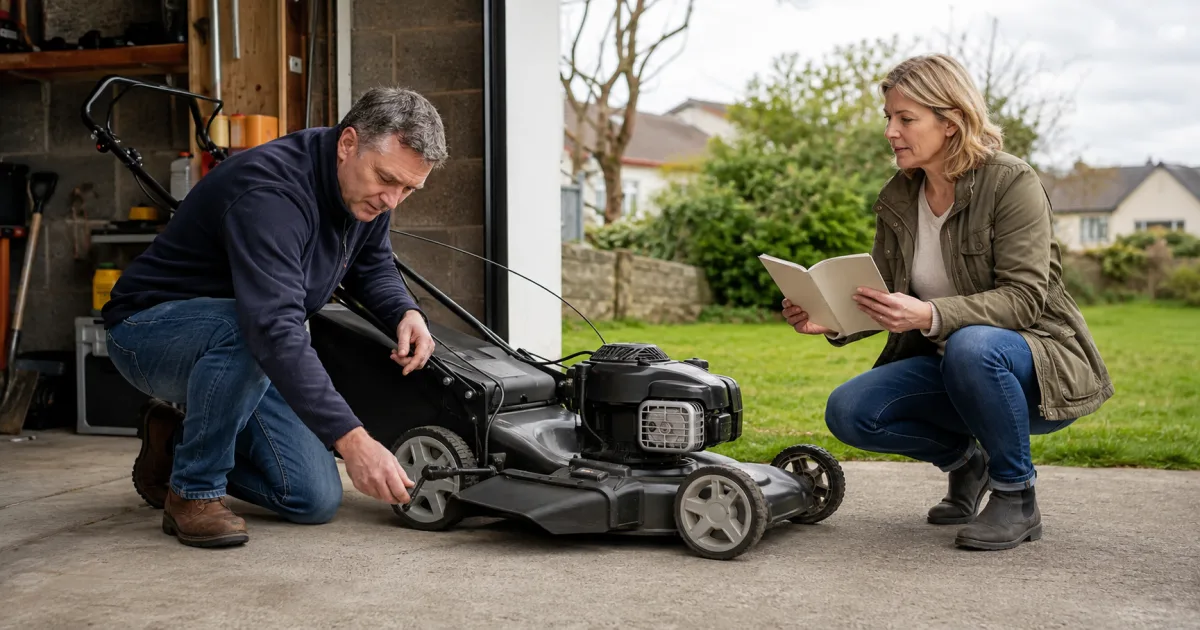
Start with the machine cool, stable and switched off. Follow the manufacturer’s isolation method: that may involve disconnecting the spark-plug lead, unplugging from the mains, removing a battery or using the robotic mower’s main switch and security procedure. Keep keys and starting devices controlled. Isolation reduces risk but does not authorise reaching into the blade area or performing work beyond your competence.
Wear sturdy footwear and keep children, pets and bystanders away. Inspect on a dry, level, well-lit surface with the seller’s permission. Do not smoke or create an ignition source around petrol. If the deck needs to be tilted or the blade condition assessed, use the model’s manual and a competent technician; incorrect tilting can spill petrol or oil and a blade can move unexpectedly.
Inspect the deck, chassis and guards
View the top, sides and accessible underside without putting hands beneath the deck. Look for rust perforation, cracks, impact dents, distorted mounting points and heavy grass corrosion. Surface rust may be manageable; thinning metal around the blade path, engine mount or wheel brackets is more serious. On plastic decks, look for splits, missing material, stress whitening and repairs near load-bearing points.
Confirm that the rear flap or discharge guard closes correctly, the collector attaches securely and every belt, shaft and hot surface is covered as designed. Never accept wire, tape or a permanently tied handle control as a repair. Ask why any guard is new or painted differently, and compare the assembly with the correct parts diagram.
Check wheels, height adjustment and handle
Roll the isolated mower across level concrete. Wheels should rotate without severe wobble, binding or rubbing the deck. Compare tyre or tread wear and inspect axles, bearings, brackets and adjusters. Set each cutting-height position without forcing it and confirm that all wheels or the central mechanism move and lock as the manual describes.
Check the handle for cracks, bending, corrosion and loose pivots. Folding joints and clamps must lock securely. Controls and cables should follow their intended route without kinks, melted sections, fraying or contact with sharp edges. Confirm that the operator-presence bail moves freely and returns; do not start a mower whose stop control is tied, bypassed or slow.
Assess the blade without taking unsafe risks
Ask when the blade was last sharpened, balanced and replaced, and whether it ever struck a stone, stump or metal object. A severe impact can affect more than the cutting edge, including the blade carrier, crankshaft or motor. Vibration after an impact is a warning that needs competent investigation, not just another sharpening.
Do not reach under the deck, hold a blade by hand or ask the seller to tip a fuelled mower casually. If an accessible visual check cannot establish condition safely, price a professional inspection or replacement. Blades, fasteners and fitting procedures are model-specific; use the correct parts and tightening method rather than a lookalike blade or reused damaged fixing.
Petrol mower checks
Ask the seller not to warm the machine before you arrive. A cold start reveals more about starting behaviour than an engine already at operating temperature. Before starting, inspect the fuel tank, cap, hose, carburettor area and engine for dampness, staining or fuel smell. Check the oil only according to the engine manual, with the mower level and off. Walk away from an active fuel leak.
Ask what fuel was used, how old it is and how the machine was stored over winter. Old fuel and poor storage can create starting and carburettor problems, but do not assume a simple clean will cure every symptom. Review service records for oil, air filter, spark plug, drive system and blade work. Fresh oil alone does not prove regular maintenance.
During a seller-operated demonstration, observe how many attempts a cold start takes, whether the engine settles to a consistent speed and whether smoke, hunting, knocking or fuel leakage appears. Brief vapour in cold conditions differs from persistent smoke, but diagnosis belongs to a competent repairer. Ensure the engine stops promptly when the required control is released.
Mains-electric mower checks
Inspect the full supply cable and plug for cuts, crushing, exposed conductors, heat damage, taped repairs or missing strain relief. Check that the appliance’s rating and plug arrangement are appropriate for Ireland and that controls and cable retention match the manual. Do not energise damaged equipment or use an improvised adaptor merely to demonstrate it.
The seller should demonstrate only from a suitable protected supply and route the cable clear of the cutting path, following the manufacturer’s directions. Confirm that the switch starts reliably and that releasing the operating control stops the motor as designed. Unusual arcing, burning smell, intermittent operation or excessive noise needs professional assessment.
Battery mower and charger checks
Identify the exact battery and charger models and verify compatibility through official documentation. Inspect battery casing, rails, contacts and latch for cracks, swelling, impact, corrosion, overheating or liquid. Do not charge or operate a damaged, swollen or unusually hot lithium-ion battery. A generic battery that fits physically may not have the correct electronics or safety compatibility.
Ask the battery’s age, storage routine, approximate runtime now and whether it ever stops under load. Run time depends on grass, cutting height, drive use and temperature, so compare it only in a realistic demonstration. Search the current replacement price before paying; an exhausted battery and missing charger can erase the apparent saving. Confirm whether any remaining warranty is transferable rather than assuming it follows the machine.
Test self-propelled drive separately
On level open ground, let the seller engage the drive as the manual directs. Observe whether it picks up smoothly, tracks reasonably straight and releases fully when the control is let go. Listen for belt slip, clicking or grinding. Check all speed settings where fitted. A machine that continues pulling after release or needs a tied control is unsafe and should not be used.
Use a controlled cutting demonstration
A no-load start does not prove that the mower cuts or collects. Ask the seller to demonstrate a short strip of dry, reasonably maintained grass after clearing stones, toys, wire and other debris. Remain at a safe distance in the location the manual permits. Do not test in rain, poor light, extreme slope or long hidden vegetation simply to complete the deal.
Look for a consistent cut, normal collection, stable engine or motor speed and no unusual vibration. Test height adjustment only with the machine stopped and isolated as required. Confirm that grass does not escape through a damaged guard and that the collector stays secure. After shutdown, wait for all moving parts to stop before approaching.
Robotic mower checks
A robotic mower is a system, not only the moving unit. Confirm the exact mower, charging station, power supply, low-voltage cable, connectors, installation accessories and account or app transfer process. Determine whether the model uses boundary wire, reference station, satellite service, local connectivity or a subscription. Price every missing proprietary component.
Ask the seller to remove the mower from their account and demonstrate legitimate ownership and the manufacturer-approved transfer or reset. Verify PIN and theft-protection requirements before payment. Inspect charging contacts, wheels, body, stop control and blade disc without touching blades. A locked mower, mismatched base or unavailable cloud support may have little usable value.
Ride-on mowers need a higher inspection standard
For a ride-on machine, check model-specific requirements and arrange a professional inspection when you are not competent to assess it. Steering, brakes, tyres, seat switch, blade interlocks, deck lift, transmission and rollover risks all matter. The seller should demonstrate controls in a clear level area. Never test safety interlocks by bypassing them, carry a passenger or operate near slopes and obstacles without the manual’s requirements.
Check parts, service support and total cost
Use the exact model on the manufacturer’s support site to find manuals, parts and an Irish service route. Confirm availability and price for the blade, collector, wheels, cables, belts, filters, battery, charger and specialist electronics that the machine actually needs. A common model with documented support may be better value than a cheaper orphaned machine.
Build a realistic first-year budget
- Purchase price and any inspection charge.
- Immediate service using the correct oil, filters, plug or consumables.
- Correct blade, fixing and professional balancing or fitting where needed.
- Battery and charger replacement for cordless equipment.
- Drive cable, belt, wheels, collector or missing guards.
- Safe fuel container or suitable protected electrical setup.
- Collection vehicle, restraints and competent lifting help.
Compare value using evidence
Compare several current Irish adverts for the same model, age, included battery or accessories and documented condition. Asking prices are not completed-sale prices. Give more weight to a cold start, working safety controls, credible service records and available parts than to a polished deck. Subtract immediate repair and replacement costs from the value of a sound complete machine.
Plan collection without spilling fuel or damaging the mower
Measure the mower at its widest and longest points and confirm how the handle folds. Check vehicle opening, load floor and anchor points. Follow the manual for transport, including fuel, battery and orientation requirements. Keep the machine upright when specified, cool before loading and secured against movement. Do not carry a petrol mower in a passenger compartment or improvised position.
Mowers can be heavy and awkward. Assess weight, grip, steps, distance and the number of people needed before collection. Use suitable ramps or handling equipment only as designed and never place yourself downhill of an uncontrolled machine. Arrange professional transport when the load or route is beyond your ability.
Seller status changes your rights
The CCPC explains that used goods bought from a business carry consumer-law protections: they must match their description, be fit for normal purpose and meet the quality reasonably expected for their age, condition and price. Disclosed wear can affect expectations, but a trader cannot disguise a commercial sale as a private one to avoid obligations.
A purchase from another consumer is generally buyer beware under consumer law. Inspect carefully and preserve the advert, seller status, model details, messages, demonstration agreement and payment record. Ask for a written receipt showing the parties, date, machine and price without exposing the seller’s private details publicly.
Protect the payment and handover
Do not pay a deposit merely because the price is urgent or another buyer supposedly exists. Verify the machine and seller before committing. Check electronic payment only in your own trusted bank or payment application; screenshots and forwarded emails are not proof. Never pay courier insurance, an account upgrade or a release fee to receive or send money, and never share a password, PIN or one-time code.
Reasons to walk away
- Identity plate is removed, altered or inconsistent with the sale.
- Seller refuses a reasonable cold start or controlled demonstration without explanation.
- Operator-presence, stop or interlock control is tied or bypassed.
- Guard, flap, cover or collector safety component is missing.
- Fuel leaks, electrical damage, battery swelling or burning smell is present.
- Deck has structural corrosion, cracks or unsafe repairs.
- Machine vibrates severely or changed after a reported blade impact.
- Robotic mower remains account-locked or lacks essential proprietary parts.
- Seller status, ownership story or payment request is inconsistent.
Final used lawn mower checklist
- Power type, width, drive and slope limits suit the garden.
- Exact mower, engine, battery and charger identities are verified.
- Correct manual, safety notices and parts support have been checked.
- Inspection was completed cool, dry and isolated from power.
- Deck, guards, wheels, handle, cables and controls are complete and sound.
- No one reached under the deck or bypassed a safety control.
- Seller demonstrated cold start, stopping and a safe short cut.
- Petrol, mains cable, battery and drive checks are satisfactory for the model.
- Service history and first-year costs support the agreed EUR price.
- Transport method follows the manual and secures the machine safely.
- Seller status, condition, included parts and payment are recorded.
The right used mower is not simply the one that starts. It is correctly sized for the garden, identifiable, complete, supported by parts and able to start, cut and stop with every original guard and control functioning. Questions asked before travelling and a safe seller-operated demonstration are worth more than a freshly washed deck or an urgent discount.
Tags
More from
New related stories are added frequently.