
By LocalAds.ie Editorial Team
How to Sell Your Old Phone in Ireland and Protect Your Data
Back up, transfer and securely erase an old iPhone or Android phone, then create an honest advert and arrange a safer sale in Ireland.
Published 7 September 2026 - 13 min read
Selling an old phone is not complete when you remove the SIM and delete a few photographs. The device may hold account sessions, messages, payment cards, health information, authentication codes, passkeys, location history and access to cloud services. A careful sale has two separate goals: leave no personal data or account lock for the next owner, and give the buyer accurate evidence about the phone’s identity and condition.
Make sure the phone is yours to sell
Confirm that you own the handset and that any device finance, employer ownership, insurance replacement condition or network obligation has been resolved. Do not sell a phone reported lost or stolen, still managed by an organisation or subject to a lease. Find the purchase receipt, repair invoices and original box if available, but remember that a matching box alone does not prove ownership.
Record the exact model, storage, colour, serial number and IMEI for your private transaction file before erasing. These details can help with support, insurance or a later dispute. Do not publish a full serial number, IMEI, receipt address or account screenshot in the advert. A serious buyer can compare identifiers in person without turning them into public data.
Inspect and test before you erase
Test the phone while you can still unlock it and open its settings. Note the battery information, storage, operating-system version, repair or parts history where the platform provides it, and any network-lock or management information. Test the display, touch surface, buttons, cameras, microphones, speakers, vibration, Wi-Fi, Bluetooth, mobile service and charging. Photograph existing damage in clear light.
Create a condition record
- Exact make, model, storage and colour.
- Purchase date, ownership history and reason for sale where known.
- Battery-health information or ordinary battery behaviour without unsupported promises.
- Repairs, replaced parts, warnings and remaining repair cover.
- Cracks, scratches, dents, screen marks, loose ports and every intermittent fault.
- Network-lock status, software version and organisational-management status.
- Case, charger, cable, box and other accessories that are genuinely included.
This record improves the advert and prevents you from discovering too late that an important screen in Settings is no longer available after the reset. Never hide a warning, edit damage out of photographs or describe a phone as ‘perfect’ because it turns on. If the battery is swollen, the case is separating, the handset becomes dangerously hot or a cable is damaged, stop using or charging it and seek competent advice rather than arranging a normal sale.
Prepare the replacement phone first
Set up the replacement device before wiping the old one whenever possible. Check that it supports your SIM or eSIM, banking applications, work access, accessibility requirements, authenticator apps and important accessories. Keep the old phone charged and connected to a trusted network during transfer, and allow enough time for cloud synchronisation and large photo libraries to finish.
Back up more than photographs
Make an inventory instead of assuming one cloud switch protects everything. Review photos and videos, contacts, calendars, messages, notes, recordings, downloads, documents, passwords, passkeys, health or fitness records, app data and chat backups. Some applications use their own export or transfer process, while work profiles and security-sensitive apps may deliberately exclude data from an ordinary device backup.
Items people commonly overlook
- Authenticator accounts, recovery codes and hardware security-key access.
- Banking, government, medical, school and employer applications.
- Locally stored downloads, voice recordings, scans and notes.
- Chat histories and media that require an in-app backup.
- Contacts stored only on the phone or SIM.
- Transit cards, event tickets, loyalty cards and payment cards in a digital wallet.
- Paired watches, hearing devices, trackers, cars and smart-home controls.
A backup notification is not proof that every important item can be restored. Open a representative selection on the new phone or another authorised destination: recent and old photographs, several contacts, a document, a message history and any essential app data. Confirm that the backup belongs to the right account and note whether an encrypted computer backup password is required. Keep at least one trusted backup until the new phone has been used successfully.
Move authentication and recovery access carefully
Two-factor authentication deserves its own step. Use each service’s official transfer, export or re-enrolment process for authenticator codes and passkeys. Confirm that the new device can sign in before removing the old one, and store recovery codes securely. Do not photograph recovery codes or send them to a buyer. If your trusted phone number will change, update it through the relevant account before losing access to the old number.
Open important banking and identity apps on the replacement device and complete any required activation through their official channels. Never ask a buyer to wait while you improvise an account recovery at collection. Equally, do not leave the old handset signed in merely because an app was difficult to transfer; resolve the access before advertising or postpone the sale.
Transfer the SIM, eSIM and memory card
Move or remove the physical SIM and any removable memory card. For eSIM, follow the mobile provider and phone manufacturer’s current transfer instructions, then ensure the old profile is erased when appropriate. Test calls, messages and mobile data on the replacement phone. A factory reset is not a substitute for confirming that your mobile number and paid service have moved correctly.
Check a removable memory card separately because its contents and erase behaviour may differ from internal storage. Transfer needed files, remove the card and keep it unless it is explicitly part of the sale. Do not advertise extra storage that the buyer will not receive.
Unpair devices and remove wallet items
Unpair a smartwatch using the manufacturer’s supported process, which may also create a current backup and remove an activation lock. Remove payment cards, transit cards and other wallet items as directed by their issuer or platform. Disconnect the phone from cars, Bluetooth accessories, smart locks and home systems, and review the account’s trusted-device list after the reset.
Do not manually delete synced data
Apple warns that manually deleting contacts, calendars, reminders, documents or photos while signed in to iCloud can also remove them from iCloud and connected devices. Other synchronised services can behave similarly. Transfer and verify first, then use the platform’s supported sign-out and complete erase process. Do not clear individual folders as a substitute for preparing the whole device.
How to erase an iPhone before selling
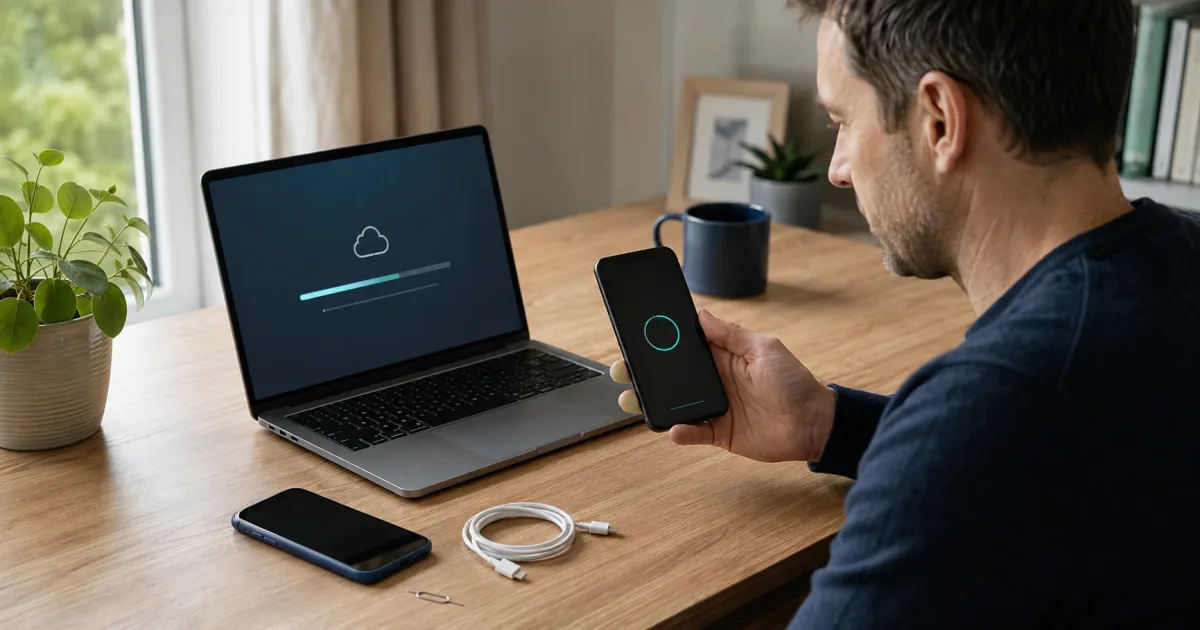
Follow Apple’s current instructions for your installed iOS version. Apple’s sale guidance begins with a backup and transfer, then covers unpairing an Apple Watch, signing out and using Settings, General, Transfer or Reset iPhone, Erase All Content and Settings. If the phone uses eSIM and is being sold, Apple advises choosing the option that also erases the eSIM profile when prompted.
Use Erase All Content and Settings—not Reset All Settings. Apple explains that resetting settings does not delete photos, messages, apps and documents. During the supported erase, you may need to enter your passcode or Apple Account password privately. Erasing through the correct flow turns off Find My and Activation Lock so the next owner can activate the phone.
If you no longer possess the phone, use Apple’s official lost-device and account guidance immediately. Remote action can protect an account, but it is a poor replacement for confirming a clean setup screen while both parties are present. Never give your Apple Account password to the buyer to solve an Activation Lock after handover.
How to erase an Android phone before selling
Android menus vary by manufacturer and version, so consult the device maker’s current instructions. Google’s guidance says to back up first, remove each Google Account from the old device, then use the supported Settings path to erase all data with a factory reset. Also remove manufacturer accounts, work profiles and other account locks using their official processes.
Reset from the Settings app after removing the accounts rather than using an improvised button or recovery procedure. This helps avoid leaving Factory Reset Protection that asks the buyer for a previously synchronised Google Account. Google also recommends knowing the device PIN and account password before beginning and checking manufacturer-specific steps. A recently changed Google Account password can introduce a security delay.
Use the supported reset—not a random wiping app
Modern phones protect internal storage through platform security and encryption, and the manufacturer’s full erase is the normal transfer process. Avoid unknown ‘military-grade’ cleaner apps, unofficial firmware or repeated destructive cycles that may expose credentials, damage the device or create a new lock. If a phone cannot complete its supported reset, seek assistance from the manufacturer or an authorised repair channel before selling it.
Verify the clean setup screen
When the erase finishes, the phone should start at its initial welcome or setup screen. Continue only far enough, with the buyer present where practical, to establish that it does not demand the previous owner’s credentials or display unresolved remote management. Do not complete setup with your personal account again. Leave the buyer to add their own accounts privately after the transaction.
Before you hand over the phone
- Required files and app data are present on the replacement device or verified backup.
- Authentication methods, passkeys and recovery access work without the old phone.
- SIM, eSIM and memory-card decisions are complete.
- Watches, wallets, cars, accessories and account trust are disconnected correctly.
- Apple, Google, manufacturer and work accounts have been removed as required.
- The supported full erase has completed.
- The setup flow does not request the previous owner’s credentials or show unresolved management.
Clean and photograph the actual phone
Power off and clean the phone according to its manufacturer’s guidance, avoiding liquid in ports and abrasive products. Use daylight and a plain background. Photograph the front and back, each edge, cameras, buttons, charging port, accessories and every defect. Screenshots taken before erasure can support battery or specification claims, but crop or redact account names, device identifiers, notifications, locations and other private information.
Write an advert that buyers can verify
Use a direct title containing the make, exact model, storage and a truthful condition phrase. In the description, state the age, reason for sale, battery evidence, repairs, network status, software version, included accessories and every known fault. Say which functions you tested and when. Avoid claims such as ‘waterproof’, ‘never repaired’ or ‘all networks’ unless you have reliable evidence for that exact phone.
A useful phone-listing order
- Make, exact model, storage, colour and EUR price.
- Ownership and purchase history without publishing private documents.
- Battery-health reading or observed behaviour and its date.
- Repairs, parts messages, cosmetic marks and functional faults.
- Network-lock, account-lock and management status.
- Functions tested, untested features and software version.
- Included case, cable, adapter, box or receipt, described precisely.
- Approximate Irish collection area, testing plan and delivery terms.
Compare current Irish asking prices for the same model, capacity and condition, then account for battery service, repair history and accessories. A business-refurbished device with a defined test process, returns and warranty is not a direct price match for a private phone. Set a realistic asking price and lowest acceptable figure before enquiries begin rather than inventing other offers.
Know your seller status
An occasional private sale of your own phone differs from buying, refurbishing and reselling phones as a business. Irish consumer protections generally apply when a business sells second-hand goods, while a private consumer-to-consumer sale does not carry the same protections. A trader must not disguise commercial selling as private. Describe your status honestly and meet the legal information and remedy obligations that apply if you are acting as a business.
Arrange a safe test and handover
Keep early contact in direct messages and share only an approximate location. Meet in a well-lit public place with mobile coverage, Wi-Fi where needed and enough time for inspection. Tell someone about the meeting. Let the buyer test ordinary functions without exposing either person’s account credentials, and do not allow the device to leave your sight before verified payment.
Agree the EUR price, included accessories and payment method before the final reset. Check payment in your own bank or payment application; a screenshot, email or buyer-controlled webpage is not confirmation. Ignore requests to pay courier insurance, release fees or an account upgrade to receive money. Never disclose a card PIN, banking password or one-time code.
A controlled handover order
- Buyer inspects the phone and reviews the disclosed condition while it is still testable.
- Both sides agree the final price and included accessories.
- Seller completes any remaining account removal and the supported full erase privately.
- Both sides confirm that the setup screen no longer requests the seller’s account.
- Seller verifies cleared payment through their own trusted channel.
- Both sides keep a simple receipt with date, model, price and appropriate identities.
- Buyer completes personal setup after the seller has left.
If the phone is posted
Use a delivery service that accepts devices containing lithium batteries and follow its current packaging and labelling rules. Photograph the condition, accessories, powered-off phone and completed package without exposing identifiers. Use rigid protective packaging, prevent movement and choose tracking or insurance appropriate to the value. Do not post a damaged or swollen battery. Define dispatch timing, delivery evidence and business return terms where applicable before payment.
Final data-protection checklist
- Ownership, finance, insurance and management status permit the sale.
- The exact phone identity and pre-erase condition are recorded privately.
- Backups and transfers have been tested rather than merely started.
- Authenticator apps, banking access, passkeys and recovery routes work elsewhere.
- SIM, eSIM, memory card, watches, wallets and paired systems are resolved.
- All relevant accounts and activation protections are removed through official steps.
- The supported complete erase finishes and the welcome screen is verified.
- The advert discloses repairs, battery evidence, faults, accessories and seller status.
- Payment is checked independently and the handover is documented.
The safest time to sell your old phone is after the replacement is genuinely working, not merely after it arrives. Verify what matters, remove accounts in the correct order, complete the manufacturer’s full erase and prove that the next owner can begin setup without you. That process protects your data, prevents an unusable locked-phone dispute and gives an honest buyer the confidence to pay a fair price.
Tags
More from Seller guides
10 min read
What Can I Sell Online in Ireland? A Room-by-Room Guide
A practical way to find saleable items around your home, decide what is worth listing and turn a clear-out into useful local ads.
11 min read
How to Sell Multiple Items Online Without Losing Track
A simple listing workflow for an Irish home clear-out, move or stock reduction, including batches, photos, pricing and buyer handovers.
9 min read
How to Prepare a Used Item for Sale Online: 30-Minute Checklist
Clean, test, measure and photograph a used item efficiently so buyers can understand its condition before they contact you.