
By LocalAds.ie Editorial Team
How to Sell Used Kitchen Appliances in Ireland
Prepare, test, photograph and price used kitchen appliances honestly, then arrange a safer demonstration, payment and collection in Ireland.
Published 7 September 2026 - 12 min read
A used kitchen appliance sells more easily when the buyer can answer four questions from the advert: exactly which model is it, what works, what is wrong and how will it leave the property? Cleaning helps, but evidence matters more than shine. Test the functions you intend to claim, disclose faults plainly and plan disconnection and collection before enquiries arrive.
Decide whether it should be sold
Sell only an appliance you own or have clear authority to transfer. Confirm that its identity plate remains intact, search recognised recall information and consider whether it is safe and economical for another household to use. An appliance with damaged wiring, dangerous modification, severe corrosion, leaking refrigeration pipework or an unresolved recall should not be presented as an ordinary working item.
A repairable fault can be advertised honestly as faulty or for parts when the listing explains what is known and does not encourage unsafe use. Do not diagnose a problem you have not verified or promise that a repair is cheap. If the item is unsafe, contaminated, irreparable or unwanted by legitimate repairers, use an authorised WEEE collection route rather than passing disposal cost and risk to a buyer.
Good sale candidates
- A working appliance being replaced because of a move, redesign or capacity change.
- A tested spare that has been stored clean, dry and correctly.
- A professionally repaired or refurbished unit with accurate documentation.
- A clearly described faulty appliance useful to a competent repairer, where safe transfer is possible.
- Complete small appliances with the accessories needed for normal use.
Know whether you are selling privately or as a business
An occasional sale of your own household appliance is different from regularly sourcing, repairing and reselling appliances commercially. The CCPC states that businesses selling second-hand goods remain subject to consumer law and cannot disguise themselves as private consumers. If you are acting as a trader, identify the business correctly, provide required pre-contract information and follow the legal obligations that apply to the sale, delivery, installation and after-sales remedy.
Private sellers should still be accurate and transparent. Do not claim ‘perfect’, ‘fully serviced’ or ‘as new’ when you have only switched the item on. State the test completed, its date and anything you could not verify. Keep the advert and direct-message answers consistent so the buyer understands what is—and is not—being offered.
Record the appliance before cleaning
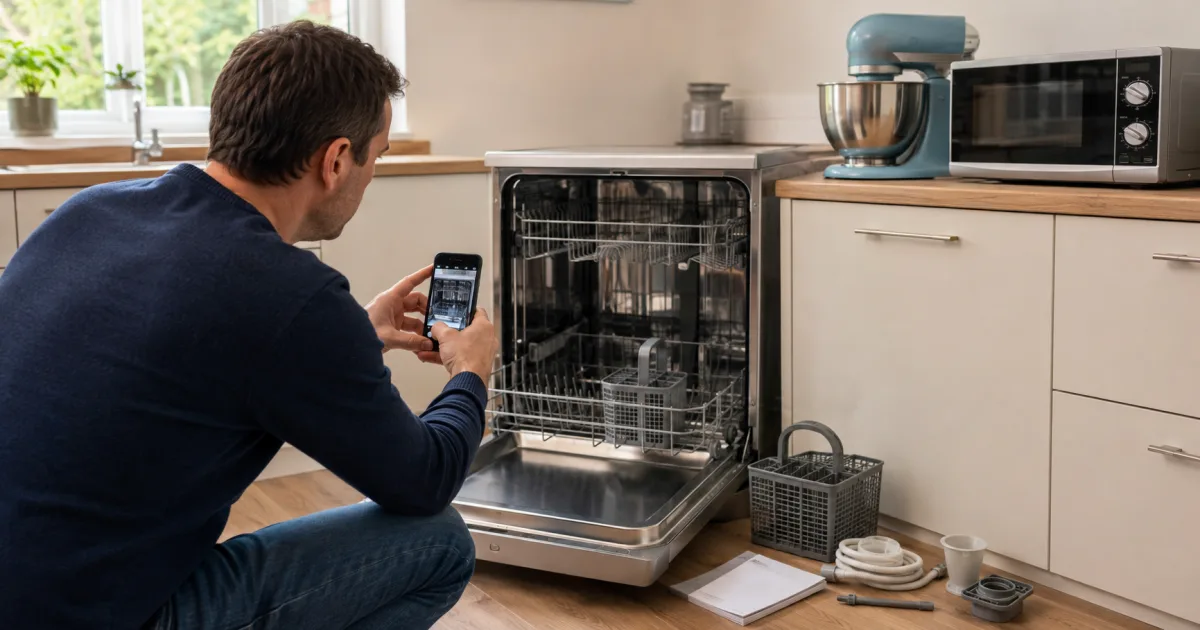
Photograph the installed condition and any existing faults before preparation. Record manufacturer, full model identifier, approximate age, external dimensions, usable capacity and the accessories present. Keep purchase receipts, repair invoices, manuals and energy information where available. Redact private names, addresses and payment details before sharing documents, and consider whether a complete serial number should remain private until a serious buyer needs it for verification.
Build a fact sheet
- Appliance type, manufacturer and exact model.
- Freestanding, integrated, countertop or other installation format.
- Width, height, depth, door clearance and approximate weight.
- Capacity, main programmes or zones and essential connection type.
- Purchase date if known, ownership history and reason for sale.
- Repairs, replaced parts, service evidence and every known fault.
- Shelves, trays, racks, hoses, brackets, manuals and other included parts.
Test before disconnecting
Complete a normal functional test while the appliance remains connected safely in its existing installation. Never improvise a water, gas or high-load electrical connection just to make a video. Follow the manual and stop if there is a leak, burning smell, damaged cable, unusual heat or other safety concern. Record the date and exact scope of the test rather than turning one successful function into a claim about the whole appliance.
Useful evidence by appliance
- Dishwasher: fill, circulation, detergent flap, heat, drain, racks, seals and leaks.
- Fridge freezer: both compartments reaching stable temperatures, door seals, controls, lights, frost and noise.
- Electric oven or hob: controls, elements or zones, fan, lights, timer where relevant, door and seals.
- Extractor hood: each fan speed, lights, filters and abnormal vibration.
- Microwave: door and interlocks, controls, turntable and ordinary heating test following the manual.
- Mixer, blender or processor: each speed, safety interlocks, bowl or jug, blades and all included attachments.
A short video can support an advert when it shows the actual appliance operating safely, but it is not a warranty of future performance. Do not film identifying household details, people without consent or unsafe close-ups near moving and hot parts. Buyers should still inspect at collection, and powered equipment should be demonstrated only in an appropriate setup.
Clean without hiding defects
Unplug the appliance before cleaning unless the manual requires a specific powered maintenance step. Use the manufacturer’s instructions and products suitable for the surfaces. Remove ordinary food residue, grease and detergent buildup; clean drawers, shelves, racks, filters and accessible seals. Dry thoroughly. Do not paint corrosion, glue a structural break or use fragrance to mask overheating, mould or drainage odour.
For refrigeration, remove food and allow any agreed defrosting only at a time that still permits the buyer to see credible cooling evidence later. Never attack ice with a sharp tool. For dishwashers, clean the filter and check accessible spray arms and racks. Keep sharp accessories guarded and small parts together. Hygiene improves presentation, but the listing should still disclose stains, chipped enamel, persistent odour or damage.
Find the energy information
Use the exact model to locate the official energy label or product information where available. SEAI explains that appliance labels provide more than a letter grade: they include energy consumption and category-specific information such as capacity, water, performance or noise. Put the relevant figures in the description without changing units or guessing. Buyers can then compare total running cost as well as asking price.
Older appliances may carry a previous label scale, so state what the documented label shows rather than converting it informally to the current A-to-G scale. Do not call a product energy efficient merely because it once had a high-looking grade. The actual kWh figure, appliance size and expected use are more useful evidence.
Take a complete photograph set
Use even daylight, a tidy background and photographs of the actual item. Start with a straight full view, then show both sides, top, rear where safely accessible, interior, doors, controls and connections. Photograph the model plate clearly while considering serial-number privacy. Include every accessory and a close-up of every notable scratch, crack, dent, stain or missing part.
Essential listing photographs
- Complete front view with doors closed.
- Interior with shelves, racks, drawers and trays visible.
- Controls and display powered normally where safe.
- Data plate showing the exact model.
- Plug, cable, hoses and ordinary connections without exposing live parts.
- Rear and sides once safely accessible.
- Included accessories arranged together.
- Separate close-ups of each disclosed defect.
Do not reuse catalogue photos as the main evidence, copy another seller’s gallery or remove faults digitally. Buyers need to recognise the appliance they will collect. Avoid showing a full home address, alarm panel, keys, family photographs, documents or reflections containing private information.
Write a searchable, honest title
Use the appliance type, manufacturer, model or capacity and one truthful distinguishing feature. ‘Freestanding 60 cm dishwasher, tested and draining’ is more useful than ‘bargain kitchen item’. Do not stuff the title with unrelated brand names or claim ‘new’ for an installed appliance. Select the canonical appliance category and use EUR for the price.
Answer the buyer’s questions in the description
A useful description order
- Exact appliance and model, format, capacity and dimensions.
- Approximate age, reason for sale and normal usage history.
- Test performed, test date and results by major function.
- Known faults, cosmetic wear, repairs and unavailable tests.
- Energy information and manual link or documents where available.
- Every included and missing accessory or fitting.
- Approximate collection area, floor, stairs, lift and parking details.
- Disconnection, lifting, delivery and payment responsibilities.
State ‘collection only’ only after deciding how a buyer can inspect and remove the item safely. If offering delivery, define the radius, fee, timing, unloading help and whether installation is excluded. Never promise installation unless you are competent, insured and legally permitted to provide it. A delivery offer does not make a private seller a qualified installer.
Price the complete package
Compare current Irish adverts for the same or closely similar model, age, condition and seller type. Asking prices are not confirmed sale prices, so use several realistic comparisons. Adjust for documented repair, guarantee, energy use, missing parts, cosmetic damage, urgent collection and delivery. A business-tested appliance with after-sales obligations is not a direct price equivalent to an unverified private item.
Set an asking price, a lowest acceptable price and a date to reduce or recycle before publishing. Do not invent competing offers or hide a mandatory delivery charge. Bundling matching appliances may simplify a kitchen clearance, but give an individual condition description and price logic for each unit so one faulty product is not concealed inside the package.
Handle enquiries without giving away privacy
Keep early questions in direct messages. Share the approximate area, not a precise residential address, until the item, price and collection window are agreed. Answer requests for dimensions, model and fresh detail photographs consistently. Be cautious when somebody ignores the appliance and immediately introduces a courier, account upgrade, insurance payment or link for receiving money.
Arrange a controlled demonstration
Agree which functions the buyer can observe before disconnection and how much time the test needs. Have another adult present, keep unrelated rooms closed and secure children, pets, keys and documents. Do not allow unqualified dismantling, removal of covers or experiments with wiring, gas or plumbing. End the viewing if a person will not respect safe boundaries.
Disconnect safely
Follow the model instructions. Unplug portable or plug-connected equipment, isolate water correctly, drain residual water and cap or control hoses without forcing fixed fittings. High-load, hard-wired and integrated appliances may require a competent electrical professional. For gas appliance installation, service or repair, official RGI guidance says to use a Registered Gas Installer; do not treat gas work as a buyer’s quick DIY collection task.
Keep washing-machine transport bolts, refrigeration shelves, dishwasher racks and oven trays secured according to their manuals. Do not lift appliances by doors, handles, control panels, cables, hoses or pipework. Make clear whether the buyer must bring an appliance trolley, protective blankets, straps, a suitable vehicle and enough capable helpers.
Confirm payment independently
Agree the final price after inspection and before loading. For an electronic transfer, confirm cleared funds inside your own banking service; a screenshot, email or buyer’s phone is not proof. You never need to pay a courier, buy a gift card, upgrade an account or disclose a PIN, password or one-time code to receive legitimate payment. Do not let loading pressure replace verification.
Use WEEE routes when sale is not responsible
WEEE Ireland states that household electrical waste can be recycled free at civic amenity sites and recycling centres, with other authorised collection options available. Retailers also have specified like-for-like take-back obligations when supplying new electrical equipment. Check current instructions, prepare the appliance clean, empty and disconnected as required, and use an authorised route rather than leaving it outdoors or giving it to an unverified waste collector.
Final seller checklist
- You own the appliance and it is appropriate to sell rather than recycle.
- Exact model, dimensions, age, energy information and accessories are recorded.
- A safe normal test supports every working-condition claim.
- Faults, repairs, missing parts and unverified functions are disclosed.
- Original photographs show the exterior, interior, plate, connections and damage.
- EUR price reflects comparable Irish condition and total collection friction.
- Demonstration, disconnection, lifting and transport responsibilities are agreed.
- Cleared payment is verified independently before the appliance leaves.
The strongest used-appliance advert is almost boring in its precision. It tells the buyer exactly what the machine is, shows its real condition, explains how it was tested and removes surprises from collection. That evidence attracts serious local buyers, supports a fair price and keeps a useful appliance in service without hiding risk.
Tags
More from Seller guides
10 min read
What Can I Sell Online in Ireland? A Room-by-Room Guide
A practical way to find saleable items around your home, decide what is worth listing and turn a clear-out into useful local ads.
11 min read
How to Sell Multiple Items Online Without Losing Track
A simple listing workflow for an Irish home clear-out, move or stock reduction, including batches, photos, pricing and buyer handovers.
9 min read
How to Prepare a Used Item for Sale Online: 30-Minute Checklist
Clean, test, measure and photograph a used item efficiently so buyers can understand its condition before they contact you.