
By LocalAds.ie Editorial Team
How to Write a Classified Ad That Answers Buyers’ Questions
Write a searchable, trustworthy classified advert that explains exactly what is for sale, its condition, price and handover before buyers need to ask.
Published 7 September 2026 - 14 min read
A useful classified advert lets a stranger answer four questions quickly: what exactly is for sale, what condition is it in, does it suit their needs and how would the deal happen? If those answers are missing, serious buyers must send basic questions, unsuitable buyers make contact and everyone loses time. The strongest description is not the longest or most enthusiastic one. It is specific, easy to scan and consistent with the photographs.
Write from verified facts rather than sales language. Record the exact item, model, size, contents, history, faults, price and handover terms before opening the listing form. Then arrange those facts in the order a buyer needs them. This guide uses ordinary second-hand goods; cars, property, jobs and regulated products require their own specialist details and checks.
Begin with the buyer’s decision
Imagine the buyer comparing five similar adverts on a phone. They need to identify the item, eliminate the wrong size or version, judge whether the condition justifies the price and know whether collection is practical. Build the advert for that decision, not as a story about why you once loved the product. A short reason for sale can add context, but it should never replace specifications or condition.
Questions the advert should answer
- What is the exact item, brand, model and variant?
- What is included in the stated EUR price?
- How old is it and how has it been used?
- What works, what has been tested and what remains untested?
- What wear, damage, repair or missing part exists?
- What dimensions, capacity, size or compatibility decides suitability?
- Where is collection and is postage or delivery genuinely available?
- When can the handover happen and how should a buyer make contact?
- Is the seller acting privately or as a business?
Use a title people actually search for
Put the ordinary item name first, then add the brand, model and one decisive attribute. ‘Oak dining table, 160 cm, seats six’ is more useful than ‘Beautiful table must go’. ‘Cordless drill kit, 18 V, two batteries’ identifies the product better than ‘Powerful tool bargain’. Use the wording printed on the item after checking it; do not guess a model from a similar online photograph.
Keep the title factual and readable. Avoid repeated capitals, emoji strings and vague urgency. Do not add near me or a list of counties merely to capture searches. The category and location already provide local relevance. Never claim new, refurbished, genuine, rare, vintage or under warranty unless the facts support that term.
Open with a two-sentence summary
The opening should identify the item and its honest headline condition, then name the main inclusion or constraint. For example: ‘Used solid-wood dining table in good functional condition with normal marks shown in the photos. Measures 160 × 90 cm, seats six, chairs are not included and collection is from Naas.’ A buyer can immediately decide whether to keep reading.
Do not waste the opening on phrases such as grab a bargain, first to see will buy or no time wasters. They provide no evidence and can make the seller sound difficult. Replace each slogan with a fact: a measurement, test result, collection window or clearly photographed feature.
Identify the exact item
Copy the manufacturer and model from a label when safe, then confirm the variant, colour, material, capacity, power rating or storage size. A family of products may share a name while using incompatible accessories. If you cannot establish the precise version, state what is known and what remains uncertain instead of selecting the closest-looking specification.
Serial numbers can support a private receipt or ownership check but generally should not be published in full. Keep account identifiers, device IDs, registration documents and personal records out of the advert. Provide enough model information for compatibility without exposing data that has no legitimate role in a public listing.
Define exactly what the price includes
List every meaningful component: charger, battery, remote, shelves, mounting hardware, case, manuals or matching chairs. Say what is absent when a buyer would normally expect it. If photographs contain display props or nearby items, explicitly exclude them or retake the images. For a bundle, provide a count and useful breakdown rather than saying everything pictured when the image is ambiguous.
State one clear price in EUR and whether postage or delivery costs extra. Avoid €1, free or POA when a higher mandatory payment is required. If offers are welcome, decide your private minimum but keep the public wording simple. A buyer should never learn about an unavoidable charge only after making contact.
Describe condition with observations
Terms such as excellent or good are subjective. Follow the grade with evidence: what was tested, what wear is visible and what changed during ownership. ‘All four hob zones and oven heated during a brief test on 6 September; timer display is dim and the rear-left knob is cracked’ is more useful than ‘works perfectly for its age’. Use perfectly only when you can genuinely establish every implied function.
Separate cosmetic condition from function. A scratched drill may operate correctly; an immaculate laptop may remain untested. Record repairs, replaced parts, modifications, water exposure, smoke or pet environment where relevant. Do not describe a suspected repair as easy or cheap unless a competent diagnosis and current estimate support it.
Disclose faults where buyers will see them
Name every known fault in the description and show it in both context and close-up. Do not bury an important defect after collection instructions or rely on one dark photograph. Explain how it affects use: a stain measuring roughly 4 cm on the rear cushion is different from a torn seam under load. If a function has not been tested, say untested rather than working.
The Competition and Consumer Protection Commission explains that misleading advertising can contain false, deceptive or incomplete information. It also advises second-hand buyers to examine goods and ask about history and condition. Businesses selling used goods must meet consumer obligations and ensure goods match their description; a trader cannot present as a private consumer to avoid those duties. Accurate disclosure is good marketplace practice for every seller.
Give measurements and compatibility facts
Measure the actual item instead of copying a catalogue unless you have verified the exact version. Furniture usually needs maximum width, height and depth plus any dismantled dimension. Clothing needs the labelled size and relevant flat measurements. Appliances need capacity, installation clearance and connection type. Bike frame size, wheel size, phone storage, tool battery platform and console region can decide whether an item is usable.
Explain how you measured and use a consistent unit. Centimetres are practical for household dimensions; millimetres may suit components. Do not convert a marked size into a promised fit. For compatibility, identify the equipment you successfully used it with and invite the buyer to verify their own model rather than claiming universal compatibility.
Write a compact history
Useful history includes approximate purchase date, whether you were the original owner, typical use, storage, servicing and reason for replacement. Keep receipts private until a genuine buyer needs suitable proof, and redact payment details, addresses and unrelated purchases. Avoid unsupported origin stories such as barely used if you do not know earlier ownership.
For safety-critical, high-value or collectible goods, history may matter more than a general description. Service invoices, provenance or an independent assessment can be relevant, but describe what each document proves. A box or receipt alone does not establish authenticity, current condition or ownership.
Explain collection, delivery and access
Give a town, suburb or general area—not a precise home address—in the public advert. For bulky items, state the floor, lift availability, doorway or stair constraints, whether the item dismantles and how many capable people are needed. Say whether the buyer must bring tools, blankets or a suitable vehicle. Confirm the exact meeting point privately only after agreeing the plan.
If you offer postage, state the service, tracked or insured status, dispatch timeframe, packaging approach and cost. Verify current carrier restrictions for batteries, liquids, fragile items and oversize parcels. Do not promise insurance without checking that the exact used item and declared value are covered. Never accept a supposed courier arrangement that requires an unrelated release, account-upgrade or insurance payment.
Set communication expectations
State the contact method the platform supports and a realistic response window. Keep early conversation in marketplace messaging where possible so the advert and questions remain together. Do not publish an email address, full address or other unnecessary personal data. A serious buyer can ask specific follow-up questions without moving immediately to an unknown link or external payment page.
Match every sentence to the photographs
The description and images form one claim. If the text says two batteries, show two batteries. If a table dismantles, show the fittings or explain the tested method. If a scratch is disclosed, include its location and close detail. Photograph the actual product rather than relying on a manufacturer image, and remove an old photograph when any component has been sold separately.
Use the photo order to support the copy: full view, other sides, functional details, model information, contents, measurements and faults. Descriptive alternative text should explain what each important image contributes, without repeating a list of keywords. The previous guide provides a complete workflow for producing those images.
Write for scanning without sounding mechanical
Use short paragraphs and labelled groups such as condition, included, dimensions and collection. Put critical constraints near the top. Complete sentences work well for history and faults; a list works well for specifications. Avoid a wall of text, but do not compress essential disclosure into abbreviations buyers may misunderstand.
A reusable description structure
- Summary: exact item, overall condition and main constraint.
- Specifications: model, version, size, material, capacity or compatibility.
- Included: every component in the stated price.
- Condition: tests completed, wear, faults, repairs and anything untested.
- Measurements: actual dimensions and how they were taken.
- History: age, ownership, use, storage and relevant servicing.
- Handover: general area, access, collection, delivery or postage.
- Contact: preferred platform method and realistic availability.
Avoid copied and AI-padded descriptions
A manufacturer specification can help identify features, but copying promotional text may describe accessories, warranty or performance your used example does not have. Verify every retained fact against the item. Do not copy another seller’s wording or images. If a writing tool helps organise notes, inspect every sentence and remove invented details, exaggerated claims and generic filler before publication.
Search visibility comes from accurate language buyers use: the item name, model, location, size and condition. Repeating the same phrase or adding unrelated brands does not make an advert better. It makes the description harder to trust and can attract the wrong enquiries.
Answer repeated questions by improving the advert
Keep a note of genuine questions after publication. If three people ask for dimensions, add them. If buyers assume a pictured cable is included, rewrite the contents and replace the photograph. If everyone asks whether a fault affects use, explain the test. Do not silently change a material fact after agreeing a deal; tell active buyers what changed.
Views without enquiries can indicate the price, first photograph, condition or handover is uncompetitive. No views may point to the title, category or location. Improve missing information before repeatedly deleting and reposting. When the item sells or becomes unavailable, update its status promptly rather than leaving buyers to enquire.
Category prompts for common listings
- Furniture: material, exact dimensions, stability, stains, repairs, dismantling and collection access.
- Electronics: exact model, storage, battery condition, account removal, ports, faults and charger.
- Appliances: model, capacity, age, tested programmes, cable, connection, cleanliness and transport position.
- Clothing: brand, labelled size, flat measurements, fabric, alterations, wear and postage.
- Tools: model, power source, batteries, guards, accessories, test and professional-use history.
- Bicycles: type, frame and wheel size, fit context, components, service history, wear and ownership evidence.
- Bundles: exact count, size or type range, exclusions, damaged pieces and whether splitting is possible.
Worked example: weak advert to useful advert
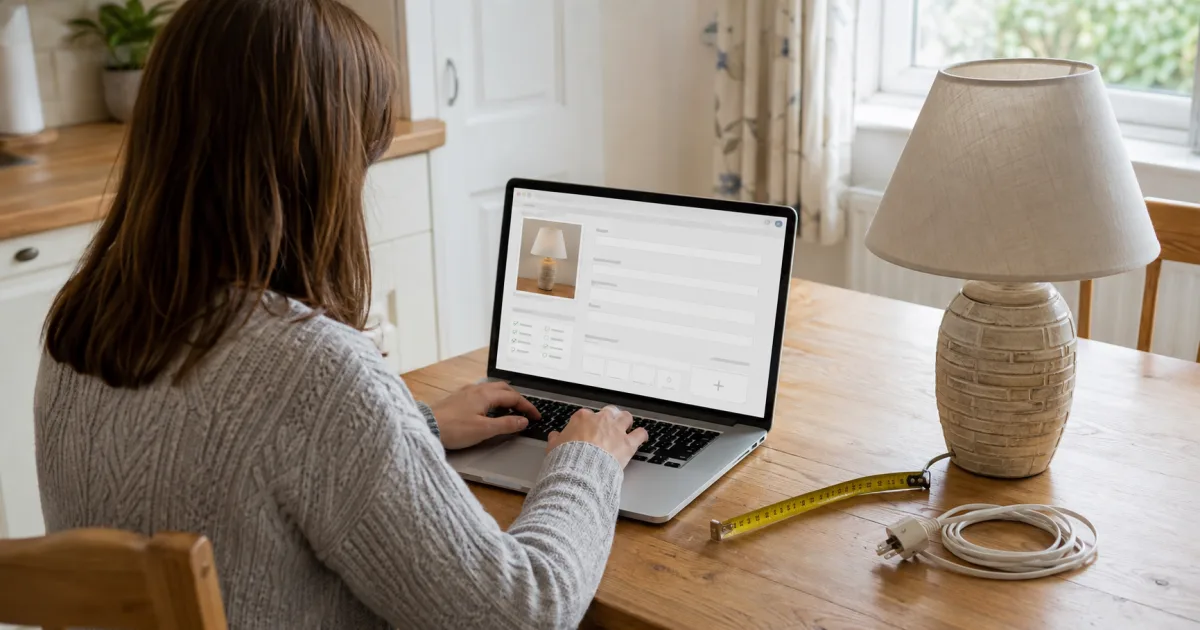
Weak: ‘Lovely lamp, perfect condition, hardly used, €45, collection only.’ This does not identify the maker, size, bulb type, included shade, cable condition, location or basis for perfect. A stronger version might read: ‘Used ceramic table lamp with cream fabric shade, 48 cm total height. Switch and bulb holder worked during a brief test; bulb is not included. One 2 cm mark on rear of base and light wear on shade edge are shown. €45 for lamp and shade. Collection from the general Dundalk area; exact meeting details agreed in messages.’
The stronger version is not persuasive because it uses more adjectives. It is persuasive because it resolves uncertainty. A buyer knows what the price covers, what was tested, where the marks are, what measurement matters and what collection means.
Final classified advert checklist
- Title begins with the real item name and verified model or decisive attribute.
- Opening identifies the condition, main inclusion and key constraint.
- Price is clear, in EUR and separates optional delivery or postage.
- Every included component and expected missing part is stated.
- Condition uses observable facts and separates tested from untested.
- All known faults, repairs and modifications are written and photographed.
- Measurements come from the actual item.
- Compatibility claims are narrow and supported.
- General location and collection access are practical without exposing an address.
- Postage claims match current carrier and insurance terms.
- Seller status is accurate and business obligations are not disguised.
- No copied content, private data or unsupported superlative remains.
- Photographs and description agree.
- The advert answers the likely questions before publication.
Write the advert as a compact inspection record. Name the product precisely, disclose its limitations, quantify what can be measured and make the handover understandable. Buyers can then spend their messages on the few details unique to their needs rather than asking what model it is, whether the charger is included or where collection happens. That saves time while building the kind of trust a local second-hand transaction needs.
Tags
More from Seller guides
10 min read
What Can I Sell Online in Ireland? A Room-by-Room Guide
A practical way to find saleable items around your home, decide what is worth listing and turn a clear-out into useful local ads.
11 min read
How to Sell Multiple Items Online Without Losing Track
A simple listing workflow for an Irish home clear-out, move or stock reduction, including batches, photos, pricing and buyer handovers.
9 min read
How to Prepare a Used Item for Sale Online: 30-Minute Checklist
Clean, test, measure and photograph a used item efficiently so buyers can understand its condition before they contact you.