
By LocalAds.ie Editorial Team
How to Package and Post Second-Hand Items Within Ireland
Choose a suitable Irish delivery service, document the item, pack for real handling conditions, protect address data and keep useful evidence until delivery is resolved.
Published 7 September 2026 - 16 min read
Postage can turn a local classified advert into an all-Ireland sale, but it also changes the transaction. The buyer cannot inspect at handover, the item must survive sorting and transport, and both people depend on the address, service and evidence being correct. Good packing begins before money changes hands: identify the exact item, weigh the complete parcel, check the carrier’s rules and agree who bears the real cost and risk.
This guide covers ordinary second-hand goods sent from one address in the Republic of Ireland to another. Carrier products, dimensions, prices, compensation and restricted-item rules can change. Check the selected provider’s current official terms for the exact contents and route before accepting the sale. Never assume that a service suitable for a book can carry a battery, perfume, blade, large television or valuable antique.
Decide whether postage is suitable
Prefer collection when the item is
- Too large or heavy for the carrier’s stated limits.
- Fragile in a way ordinary parcel handling cannot reasonably protect.
- Restricted, prohibited or uncertain under the provider’s rules.
- Valuable beyond the available compensation or proof requirements.
- Difficult for the buyer to assess without an in-person test.
- Sensitive to orientation, temperature, moisture or prolonged transit.
- Irreplaceable, personalised or lacking a safe rigid container.
- Cheaper to collect than to package and send properly.
Do not promise postage simply because a buyer requests it. Obtain a packed estimate and confirm the provider will accept the contents. A seller can offer collection only, while a buyer can decline if the journey is impractical. Clear limits in the advert prevent a rushed compromise after a price is agreed.
Agree the complete deal in writing
- Item, model, condition and every included component.
- Known faults and the inspection evidence supplied.
- Item price in EUR and the separate delivery charge.
- Who selects, purchases and controls the delivery service.
- Whether tracking, signature, compensation or declared value is included.
- Dispatch date or realistic window.
- Name and delivery address supplied privately at the appropriate stage.
- What each person will do if the parcel is delayed, damaged or returned.
- Whether the seller is a private person or a business.
Keep these details in marketplace messages where possible. Do not hide delivery charges inside vague wording, and do not promise insurance without reading what the service actually covers. A tracking number records scans; it does not prove contents, condition, adequate packaging or automatic compensation.
Private sellers and businesses are different
The Competition and Consumer Protection Commission explains that rights for second-hand goods depend on whether the seller is a business or another consumer. A trader cannot pretend to be a private seller. Businesses must provide the required product, pricing, delivery and cancellation information and comply with consumer law. An occasional private seller should still describe honestly and follow the agreed terms, but should not imply business protections that do not exist.
Measure the parcel after packing
Carriers price and accept parcels by packed weight and dimensions, not the loose item. Include the outer box, padding, inner boxes and accessories. Use a reliable scale and measure the longest external points after sealing a trial pack. Bulges and projecting handles count. Leave a small margin below service limits rather than depending on a perfect measurement.
Compare the full service: acceptance point or collection, size band, delivery estimate, tracking, signature options, compensation ceiling, excluded contents, packaging conditions, failed-delivery process and return charge. The cheapest label can become expensive if it offers no useful route for the item or evidence you need.
Check prohibited and restricted items first
Read the carrier’s current rules for the exact contents, even for domestic delivery. An Post publishes prohibited and restricted-item guidance covering hazardous goods and categories with limited or unavailable insurance. Its published list includes restrictions or prohibitions affecting items such as batteries, flammable materials, aerosols, liquids, sharp instruments without proper protection, fragile goods, glass, ceramics and valuables. Other providers may use different rules.
Do not disguise contents, detach a warning label or describe an item inaccurately to obtain carriage. If a device contains a battery, identify its chemistry, condition, whether it is installed, and the exact provider rule. Damaged, swollen or recalled batteries require specialist handling and must not be improvised into ordinary post. Ask the carrier directly when the wording is unclear.
Prepare and document the item
Before wrapping
- Photograph every side in clear light.
- Record model and a partial identifier where appropriate without publishing sensitive data.
- Show working condition or the disclosed fault.
- Photograph accessories, cables, manuals and removable parts together.
- Remove personal accounts and data from electronics.
- Clean and dry the item without concealing wear.
- Switch off, unplug and secure controls in the safe position.
- Save the advert and material buyer messages.
Documentation should be factual, not staged to imply more than it proves. A video of a device turning on does not guarantee every function; photographs taken before dispatch do not prove what happens in transit. They do, however, help both parties confirm the expected contents and may support a provider’s claim process.
Choose a sound outer box
Use a rigid corrugated box strong enough for the packed weight and large enough for protection on every side. Reused boxes can be sensible if they remain dry, square and structurally sound. Remove or completely cover old addresses, barcodes, hazardous-goods marks and routing labels. Avoid boxes with crushed corners, torn seams, grease, water damage or excessive empty volume.
The original retail box is often designed for presentation or pallet shipment, not necessarily for travelling alone through a parcel network. Place it inside a suitable shipping box when the product and service require more protection. Never allow branding on an old box to misdescribe the current contents.
Wrap each component separately
Separate hard objects so they cannot strike or rub against each other. Cover edges and protrusions, cap protected sharp points and secure loose cables without putting tight bends at connectors. Put small screws or fittings in a sealed, labelled inner bag and anchor it so it cannot disappear beneath flaps. Keep detachable heavy parts away from delicate surfaces.
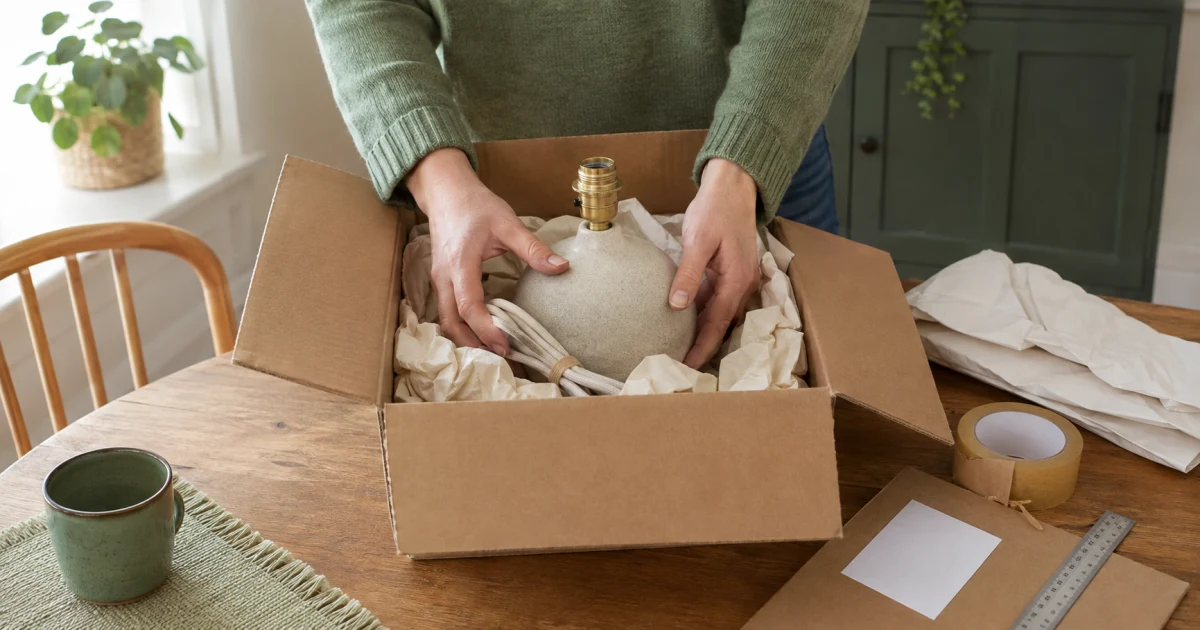
For a lamp, remove the bulb and shade when practical, secure the cable and protect ceramic or glass components separately—only if the provider accepts them and the available service is appropriate. For a games console, eject discs, remove loose batteries if permitted and suitable, protect ports and prevent controllers moving. Follow manufacturer transport guidance for the exact product.
Immobilise, cushion and separate
Packing has three jobs: keep the item away from the outer walls, absorb ordinary shocks and stop contents moving. Create a firm base, centre the wrapped item, fill voids on every side and protect the top before closing. Use clean, dry cushioning that will not collapse immediately. Crumpled paper suits some light goods; denser or double-boxed protection may be necessary for heavier or fragile items.
Perform a gentle movement check before sealing. If the contents shift, open the box and improve restraint. Do not violently shake a parcel to test it. Padding cannot make a prohibited item acceptable, and a fragile sticker does not replace correct internal protection or guarantee special handling.
Prevent moisture and surface damage
Ireland’s weather makes a sound outer package important. Where the contents and carrier allow it, use an internal moisture barrier without trapping existing damp. Keep paper goods flat between rigid protectors. Cover polished surfaces with a clean non-abrasive layer before adding cushioning. Adhesive tape must not touch painted, leather, fabric or collectible surfaces directly.
Seal the parcel for its weight
Close all flaps naturally without forcing an overfilled box. Use packaging tape across the central seam and both edge seams on the top and base. Reinforce weak points proportionately, but do not wrap the parcel in loose string or leave tape tails that can catch machinery. If the box deforms when lifted, repack it rather than adding endless tape.
Address it clearly and privately
Ask the buyer to confirm the complete delivery name, address, Eircode where applicable and any provider-required contact detail before buying the label. Copy carefully and check county, locality and postcode fields. Place one clear label flat on the largest suitable face, away from seams and edges. Protect it as the provider directs without making scanners unable to read it.
Do not publish the buyer’s address in an advert, public comment, review or proof photograph. Avoid sharing a label image with an exposed barcode or tracking number beyond the people who need it. Include a return address only as required by the service, and store shipment evidence securely.
Make an internal address card
Place a simple internal note with sender and recipient details and an item summary in a waterproof sleeve where appropriate. It may help identify the parcel if the outer label is damaged, subject to the carrier’s rules. Do not include passwords, payment-card information, unnecessary identity documents or promotional material that could damage the item.
Photograph the packing sequence
- Item condition immediately before packing.
- Serial or model evidence needed for the transaction, kept private.
- All included components.
- Individual wrapping and protected edges.
- Cushioning beneath and around the item.
- Contents positioned before the top layer closes.
- Sealed box from every side.
- Labelled parcel with personal details redacted in any shared copy.
- Acceptance receipt and measured weight.
Do not reopen or alter the parcel after taking the final evidence unless you document the new pack. Keep original files rather than compressed chat copies. Evidence should support an honest resolution, not be used to dismiss a credible problem automatically.
Buy the label through an official route
Use the carrier’s official site, app, post office or recognised outlet. Do not buy a label through a buyer-supplied payment link or send a refundable courier fee to release marketplace funds. Confirm the service and address before paying. A marketplace buyer who says a courier is already booked should still provide a verifiable arrangement that matches the written transaction.
Keep proof of acceptance
A printed label is not proof that the provider received the parcel. Obtain and retain the acceptance receipt or collection confirmation, tracking identifier, service name, date, weight and declared value where applicable. An Post explains that tracking requires a tracking number and can be checked through its Track and Trace service; check the corresponding official process for another carrier.
Send the buyer the genuine tracking reference through the marketplace without exposing unrelated personal information. Both parties should open the provider’s tracking tool independently rather than relying on a screenshot. Scans may be delayed, so use the provider’s stated escalation route instead of assuming immediate fraud.
Manage buyer expectations
State when the parcel was accepted, the selected service and the provider’s estimate without guaranteeing an exact arrival you do not control. Tell the buyer promptly about a known delay or address query. The buyer should allow the published service process to operate but raise a missing or damaged parcel quickly enough to meet complaint and claim deadlines.
When a parcel arrives
Buyer’s evidence checklist
- Check the name and address before opening.
- Photograph significant dents, tears, moisture or resealing.
- Open carefully without damaging the item or throwing away packaging.
- Compare every component with the advert and messages.
- Photograph internal protection and condition as found.
- Test safely according to the item-specific agreement.
- Report a material problem promptly and factually.
- Keep box, padding, label and delivery record while the issue is open.
If the parcel is delayed, lost or damaged
Check tracking through the provider’s official channel and confirm the delivery address. The person who purchased the service should follow its complaint process because that contract and evidence often determine who can claim. Provide the receipt, tracking, contents, value, packing photographs and damage evidence requested. Do not invent a value or discard the packaging before the provider responds.
ComReg advises first using the postal provider’s customer-service process and, if still dissatisfied, completing its advocate stage before seeking formal postal dispute resolution where eligible. Its guidance notes that evidence may include sender, addressee, declared value and the materials and markings used to package the item. Check current scope, deadlines and fees rather than assuming every courier dispute falls within the same route.
Avoid postage scams
- Do not click a buyer’s link to receive payment or book delivery.
- Do not pay account-upgrade, insurance or release fees to obtain sale proceeds.
- Verify funds in your own account before dispatch.
- Use only official carrier channels for labels and tracking.
- Confirm any collector identity and booking in marketplace messages.
- Do not refund an alleged overpayment at the sender’s instruction.
- Keep the item when payment or courier details cannot be independently verified.
Seller’s final dispatch checklist
- Postage is suitable and permitted for the exact contents.
- Packed weight and dimensions fit the chosen service.
- Item condition and included parts match the advert.
- Personal data is removed from the item.
- Each part is wrapped, separated and immobilised.
- Sound outer box is sealed for the weight.
- Old labels and misleading marks are removed.
- Address and Eircode are confirmed privately.
- Payment is verified independently.
- Label came from an official route.
- Acceptance receipt and tracking are retained.
- Buyer receives a factual dispatch update.
A successful posted sale is designed for the whole journey. The item is eligible, the service fits its packed size and value, the box protects it from ordinary handling, the address can be routed, and both parties keep enough evidence to solve a problem. Price that work honestly. If safe packing and a suitable service cost more than the item justifies, collection is the better listing choice.
Tags
More from
New related stories are added frequently.